Danaé Panchaud Co-Author, Curator, & Lecturer
Back to all videos
What does being "In Bloom" mean to Danaé Panchaud?
“Pushing the limits instead of sticking with a recipe that works but will eventually bore us.”
Transcript
Welcome to In Bloom, where we meet creatives whose work connects on nature, design and storytelling.
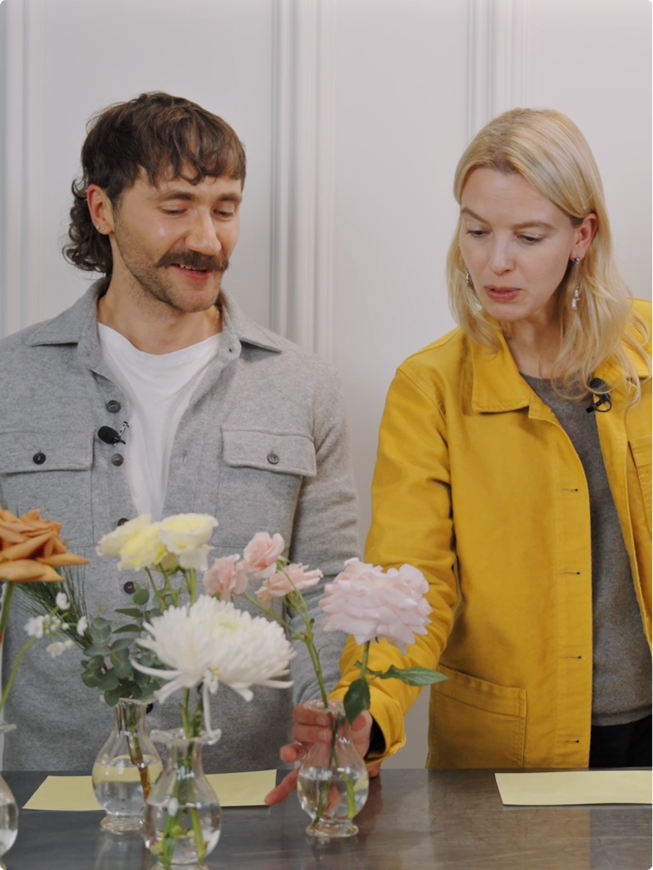
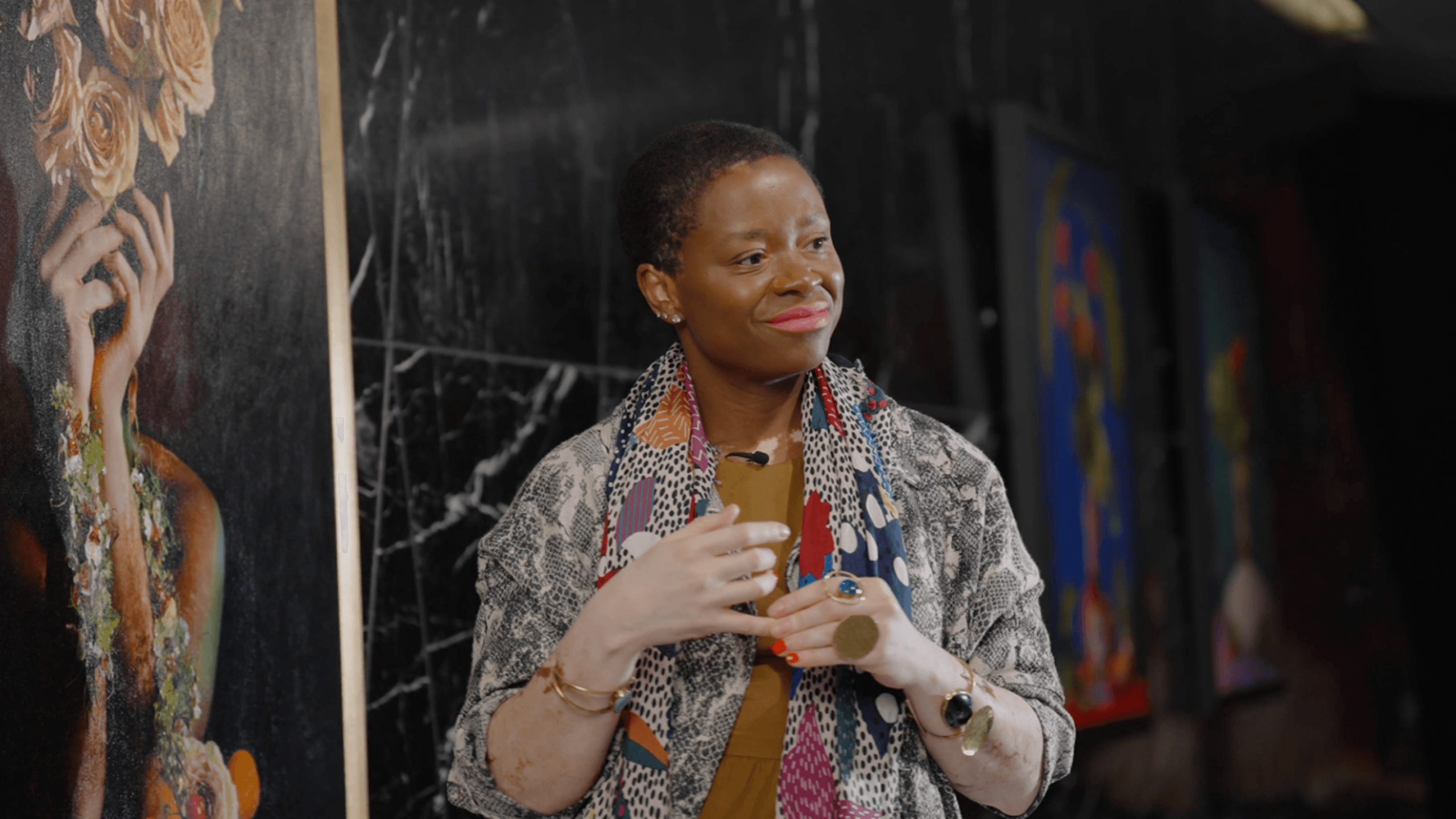
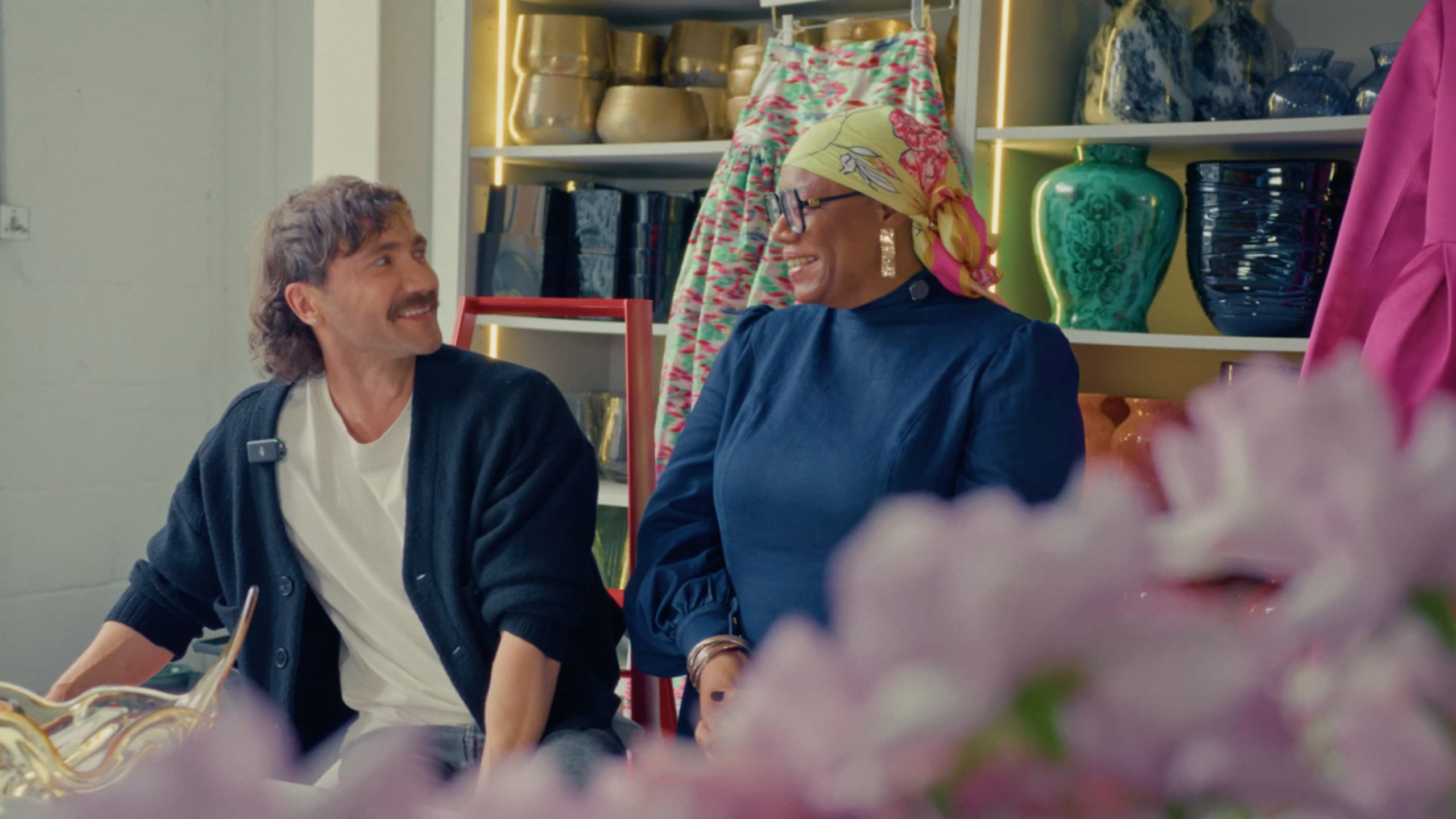
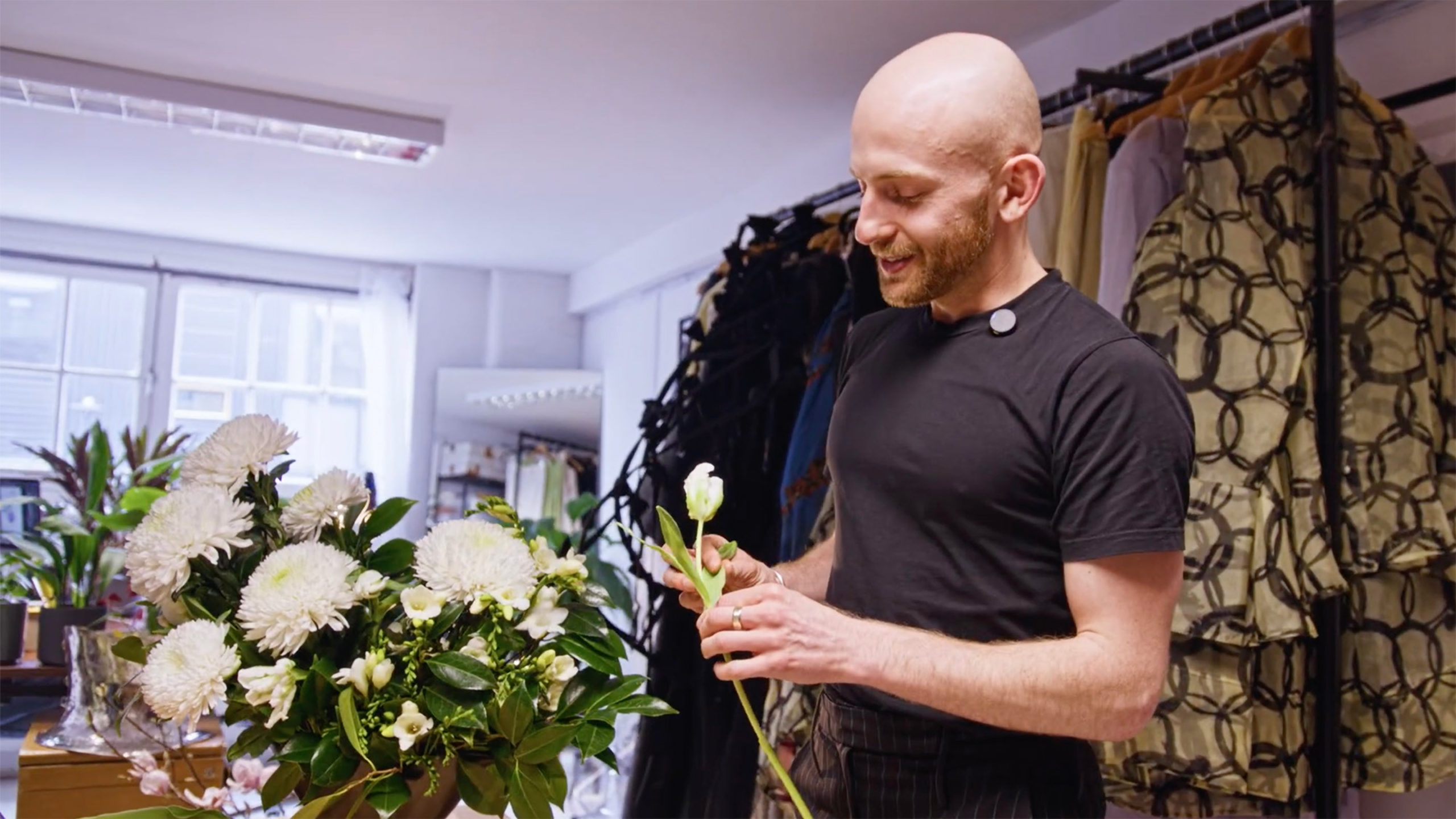
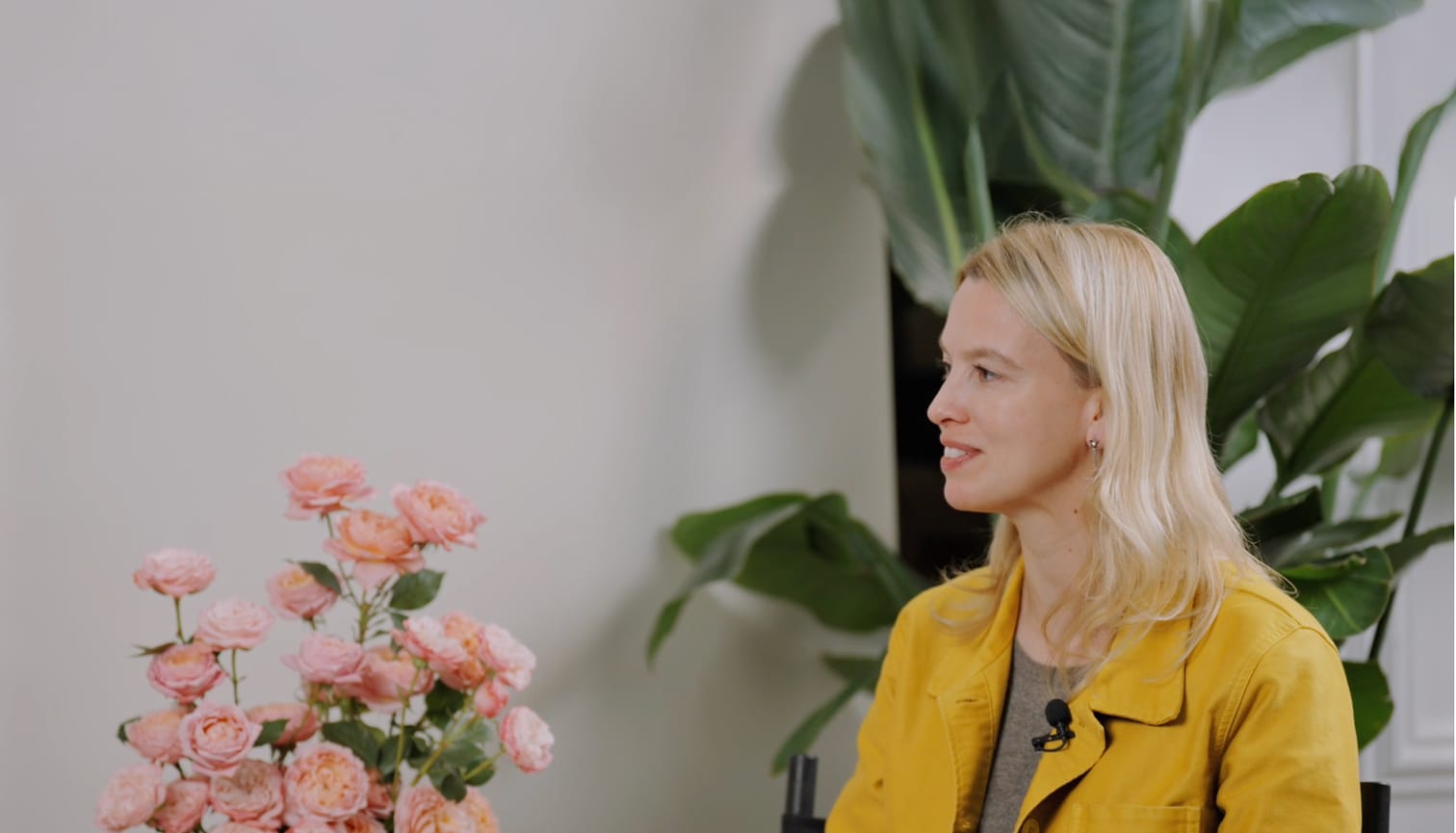
I'm Michal and I'm Michael, the co-founders of Blooming House, and today we're joined by Danaé Panchaud, curator, musicologist and lecturer, who specialises in photography. Danaé's work explores how we see and represent the world through images. She's also a co-author of Floral Photography, a book that looks at flowers in contemporary photography. We'll talk about her book, her curation process, and how photography captures the same beauty and impermanence we work with in floristry.
The book features over 100 artists. Can you tell us more about the story, how it started and how it began,
and how it evolved?
It's actually the second book on the topic. The first one was authored by William Ewing in 1991, I think, and it was a history of photography through the flower, and he was keen on revisiting the topic. He invited me to co-author the book.
How do you choose? You have so many different artists, so many different beautiful works of art. How do you go about choosing, saying, oh right, this one looks good?
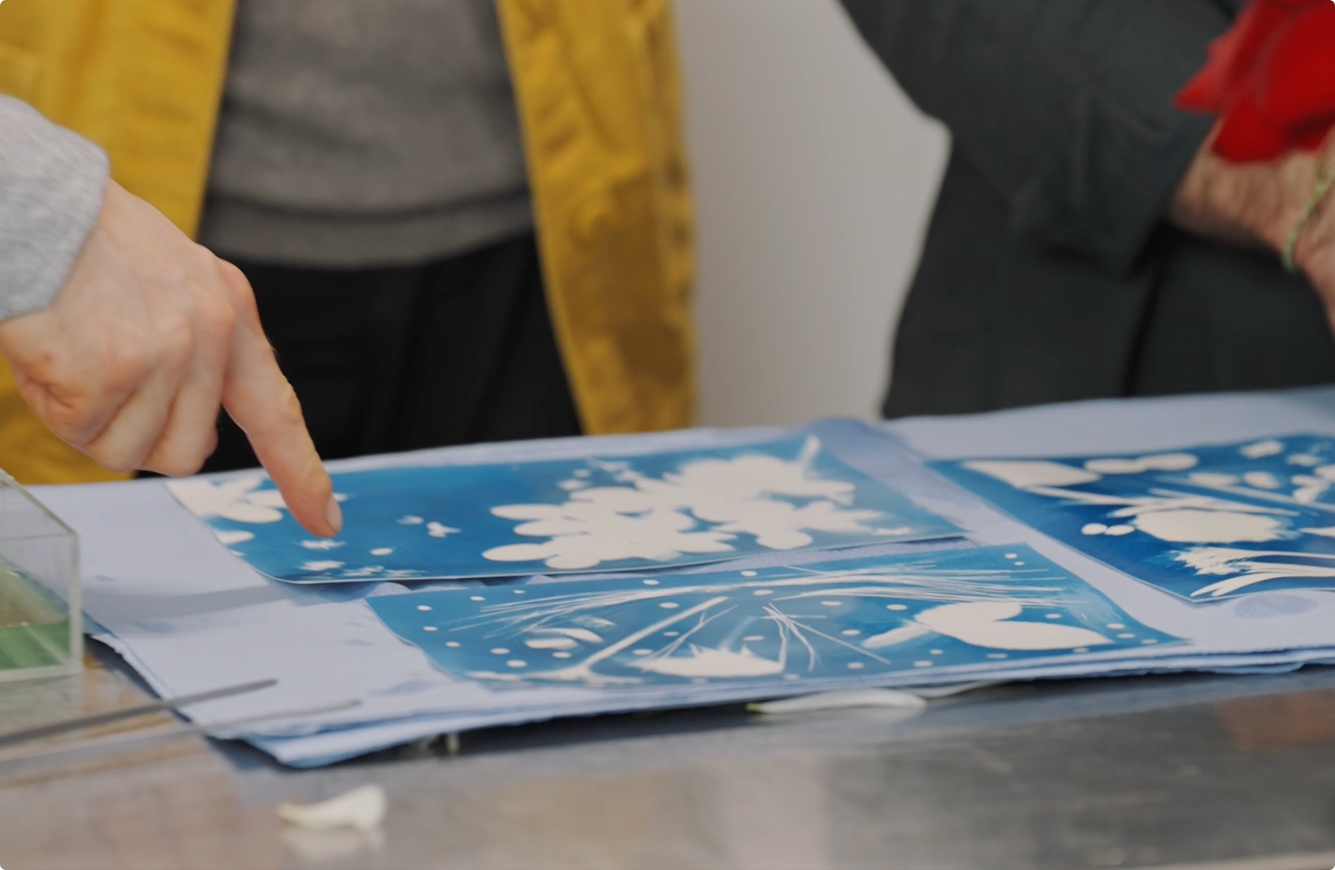
I mean, they all look good, but this one will fit within the context and this one won't fit. So we were looking initially at the material very intuitively. We were going through a lot of pictures in one day. We can really look at a few thousand pictures in one day going yes, no, maybe I'm intrigued by that. This doesn't feel so exciting anymore. And so on. So our initial work sessions was really just looking at the material without forming a very precise idea of where we wanted to go. This is a work that I adore by Leah Diez. She's a German artist, and these very simple arrangements were photographed on the market in Moldavia.
Danaé, tell us, are you a photographer yourself?
I trained, but I didn't consider myself a photographer at all, but it is useful in my job to still have a sense of how things are made and the techniques and so on.
So how do you think contemporary artists approach photography compared to past generations?
I would say in terms of flowers, it has always been proven through the history of photography, with also the limitation at the time of the technique when, you know, black and white was what was mostly available. So it has limitations to pick colourful flowers. What we are seeing now, compared to the first book that covered the entire history of photography, is a lot more colours, but also a lot more political works as well, where flowers can also be harnessed as a symbol for protest or hope.
When you curate, what draws your eyes first, your attention first? Is it the colour? Is it the subject? What do you think is the first thing that shows you are?
It can be many different things. I think my attention can be very easily distracted. My attention can be grabbed by many different things. So it is very easy?
Yeah, very easily. What are we talking about here? But I think in the end, what really keeps my attention is going to be the story, what a picture or a series of photographs are telling or conveying. I think that's what keeps my attention.
So per se, it's not the beauty of the flowers that captures you and captivates your attention. It's mainly the story behind it. Oftentimes, yes, but I'm very partial to a very beautiful picture also, it has to be said.
How do you balance research and intuition in your work? I think I start with the research in something that can be quite theoretical or very cerebral or very documentary. But then there is always an intuitive part in how we bring different works together. So I think intuition plays an important part in my work.
The most important question is why flowers?
There was this first book on the history of photography through flowers, and then we could see an abundance of new images being produced with flowers that we hadn't seen before that were really interesting. So we thought there might be a book here.
I want to say that I can see that flowers play a really, really big role in your professional life, but what role do they play in your personal life? Very sadly, I don't have a garden and I am the daughter of the queen of all things green. My mother, who grows incredible plants and flowers extremely easily, didn't come as easily to me, but I'm getting there.
So I will ask this question. What's your favourite flower?
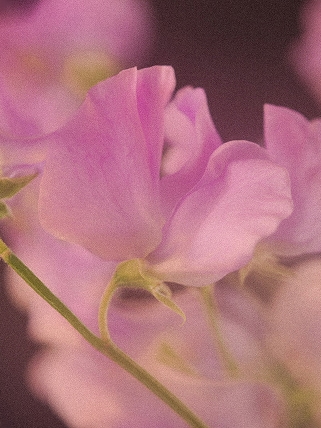
I think I'll go with sweet peas. I absolutely adore them. Extremely pretty. But they also smell so nice. And I also love them in perfume as much as fresh flowers. Cut.
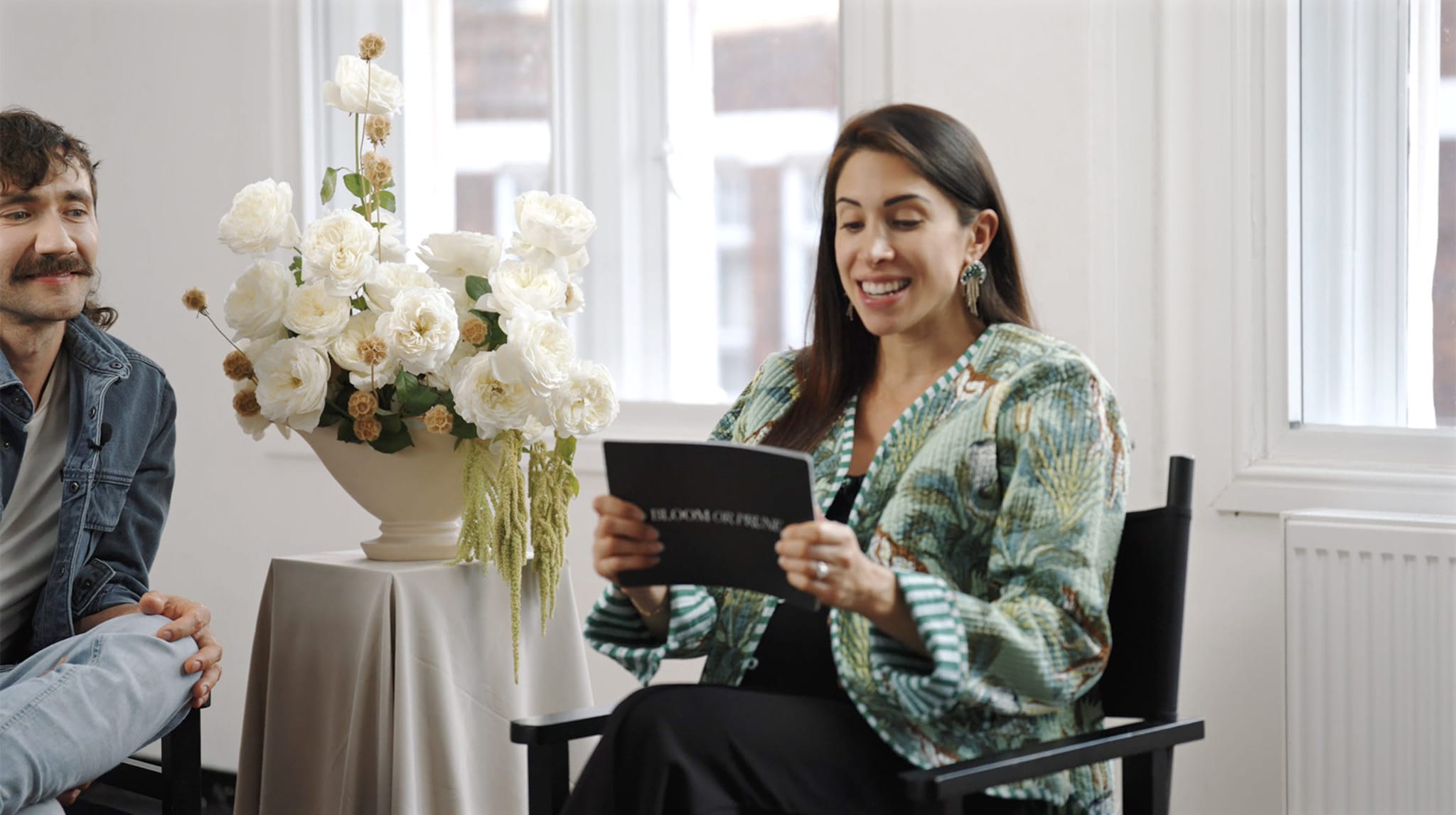
Tonight we have a game for you. It's called Bloom or Prune. So each card represents an emotion, an idea, and it's up to you to decide whether you bloom it, you keep it, you nurture it, or you prune it. We want it out.
Perfection in nature.
Oh, let's prune it. I think we should definitely stop over-optimising everything, especially nature.
Art should always have a message.
Oh, let's prune it.
Let's make it more about the art worldfavouring trends.
As much as I'd like to prune it, I think we have to deal with it. And maybe we should bloom it. Okay, we're keeping this one.
Never asking for help.
You talked to my mother, didn't you?
Yeah. We had a call.
So I would love to prune it. Will I be able to? Well, I mean, I'm gonna watch this, so be careful.
Digital over analogue.
Oh, that's a very old debate. No, I think we should prune the discussion. Maybe go with analogue.
AI in photography.
Oh, that's a tough one. That is a tough one. But I would say keep a few good things and projects by artists and prune the rest.
Yeah.
Minimalism in design?
No, that was great.
Making art just for yourself?
Of course. Absolutely. I love being an amateur artist.
Work always comes before personal life.
Another tough one. But let's gently, slowly, gradually prune it.
Finally, pushing the limits of your discipline.
Yeah, let's bloom it. Absolutely.
How do you... How do we push the limits? How do you do it? Yeah. How do we do it?
Thinking about it and not following up on recipes that we know are working, but might get us to be bored after a little while.
You said that perfume is a big passion of yours. Do you feel that this has an effect on how you curate your work, your books, and any other things that you do?
Yeah, I think some of the pictures in this book, not all of them, can be very evocative of some sense. So when there are flowers that we know of, has a very distinct and heavy scent, flowers that are starting to wilt, then suddenly we can... I think we can get a sense of what they would smell like.
How do you think smell shapes visual experiences similar to how photography holds memory?
Yeah, that's a very good question. So in our brain, the sense of smell and the part dedicated to memory is actually quite close by and very connected. So this is why also we can smell something in the street and suddenly be brought back to a childhood memory, for instance. And on the other hand, with photography, we have this very conscious gesture to hold on to a memory, to have a souvenir of a very specific moment of time. Well, this is a perfect transition into what's coming next. Shall we? Absolutely.
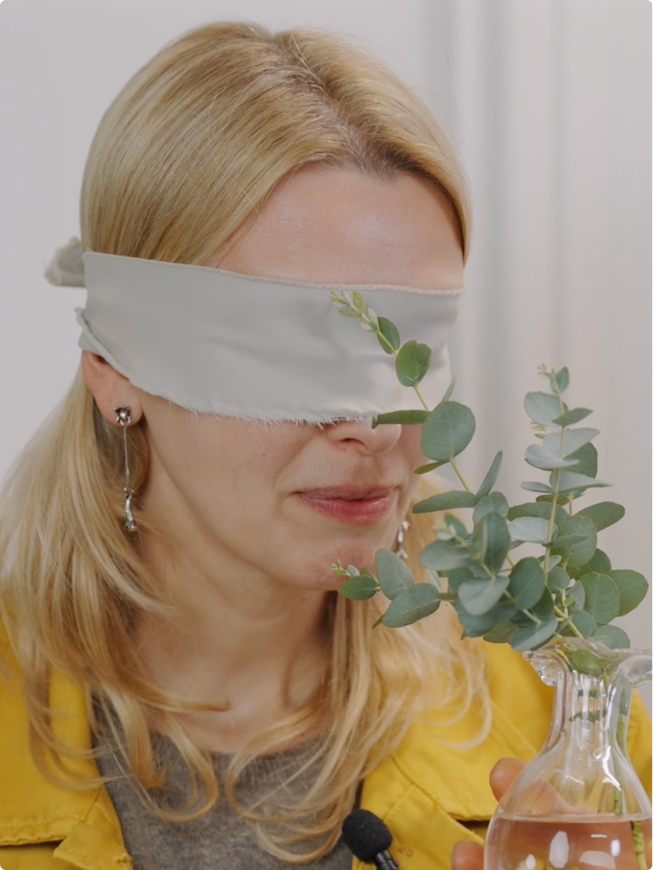
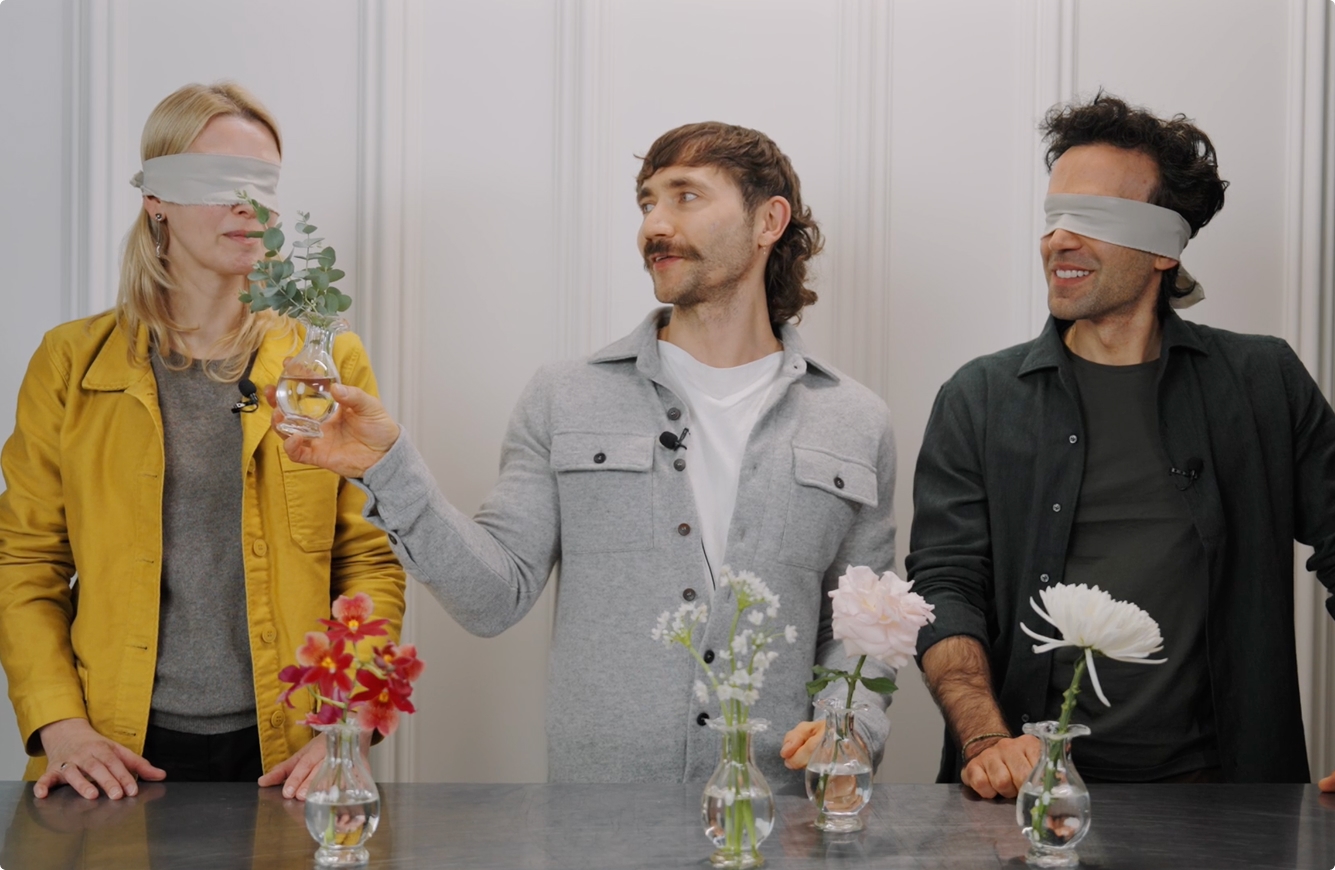
Behind the scenes with blindfolded Danaé and Michael, they can't see absolutely anything whatsoever. We have five flowers right in front of us, and are we going to be doing a testing of scent? Yeah.
Could you smell anything for me, please?
Yeah, I got it. This is eucalyptus.
Oh my God, she's really good.
This was an easy one.
Oh, it's a rose.
Oh my god. Okay, you get zero. She gets two already.
What did I get?
No, I won't say anything.
I know this one.
Chrysanthemum.
Wow. Zero to one. You were so good with that.
Oh, this is a difficult one.
Yeah.
The garlic?
Yeah. Really harsh, but yum, yum.
Really?
Yeah.
Thank you so much for joining us, Danaé. This was a great experience. We'd love learning about your work, your connection with flowers and everything you do. We wish you the best of luck for the next book. Hopefully very soon. Don't forget to join us for more interviews. We meet creatives, artists and explore their journeys and connection with flowers. See you next time!
About the speaker
Danaé Panchaud
Blooming Haus co-founders Michal and Michael have long been fascinated by how photography freezes beauty in time - capturing the same fleeting moments of bloom and decay they work with every day.
In this episode of In Bloom, they welcome Danaé Panchaud to explore the intersection of flowers, memory, and the photographic image. As a curator, musicologist, and lecturer specialising in photography, Danaé brings a unique perspective on how we see and represent the world through images.
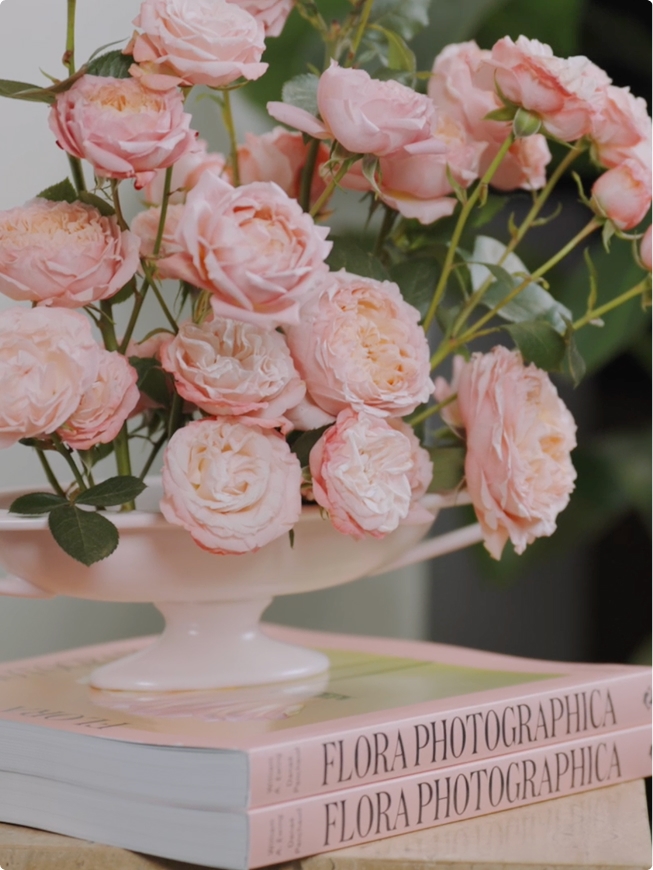
Danaé is co-author of Flora Photographica, a comprehensive look at flowers in contemporary photography featuring over 100 artists. Working alongside William Ewing on this second exploration of the subject (the first was published in 1991), she curated a collection that reveals how contemporary artists are using flowers not just for their beauty, but as symbols of protest, hope, and political meaning.
Her curatorial approach is distinctive: beginning with research and theory, but ultimately guided by intuition and story. While she appreciates beautiful images, what truly captures her attention is the narrative a photograph conveys - what it's trying to say beyond its aesthetic appeal. This sensitivity extends to all her senses: Danaé is passionate about perfume and understands deeply how scent, like photography, has the power to preserve and evoke memory.
Though she jokes about not inheriting her mother's green thumb, Danaé's love for flowers - particularly sweet peas - runs deep. For her, they represent the perfect marriage of visual beauty and fragrance, a sensory experience that transcends the image alone.
"In the end, what really keeps my attention is the story - what a picture or a series of photographs are telling or conveying. That's what keeps my attention."