
Five Floral Decoration Ideas For Your Wedding

For more floral inspiration, visit our Pinterest page.
5. Hanging installation
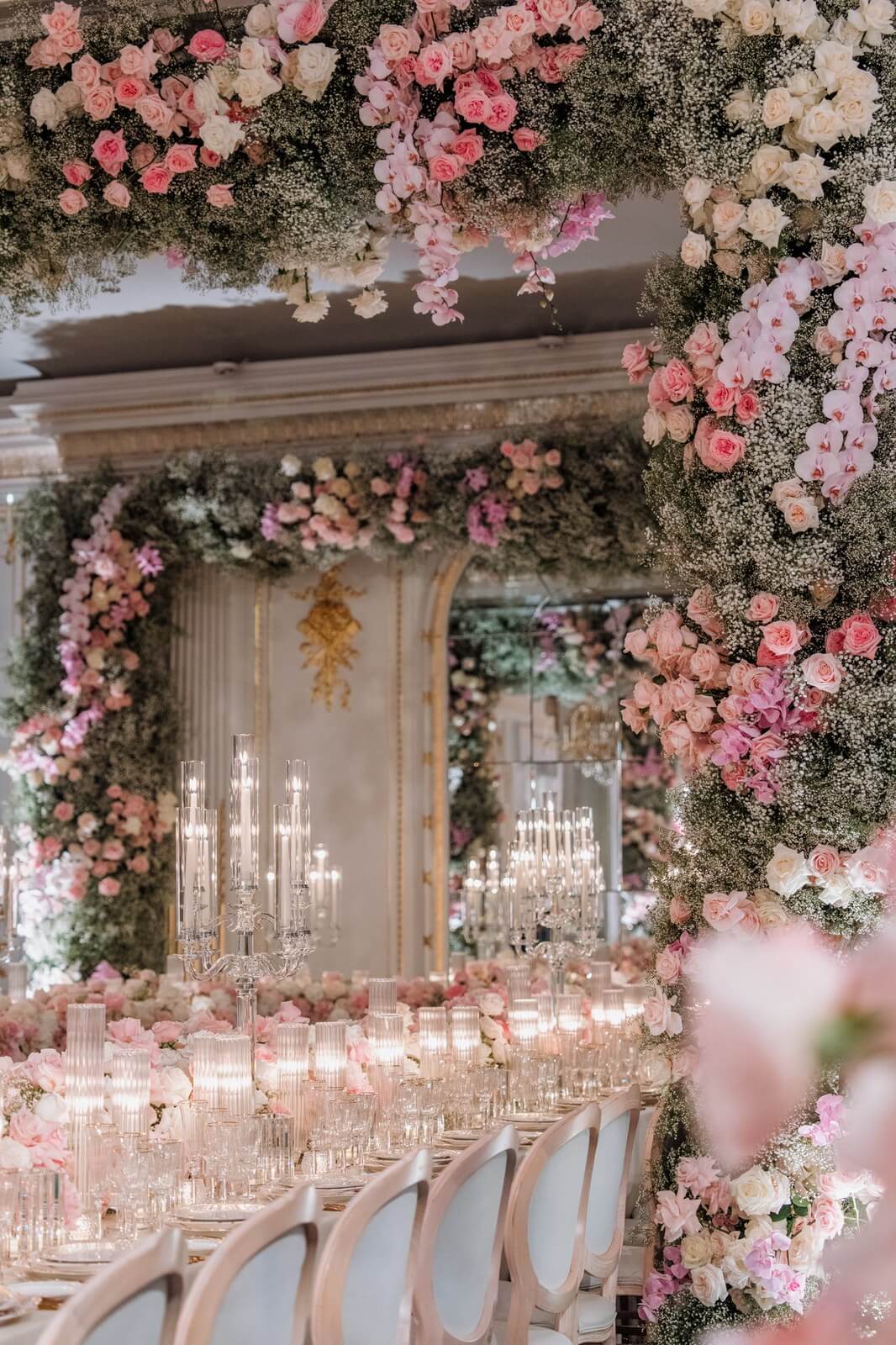
A hanging installation suspends flowers above the table or dance floor — a format that adds scale and drama without occupying any floor or table space. It can be designed to almost any specification: a dense canopy of blooms, a more open structure of trailing foliage and stems, or something in between. Because the installation hangs overhead, it becomes the focal point of the room from any angle, without interfering with sight lines or conversation. A florist or floral designer can advise on what works within the structural constraints of your specific venue.
For more floral inspiration, visit our Pinterest page.
4. Flower wall
A floor-to-ceiling flower wall is one of the most impactful installations available — a backdrop that works for the vow exchange, the reception, and the photographs in equal measure. It brings an outdoor quality into interior spaces and tends to become the most photographed element of the day.
Flower walls don’t need to be densely packed to be effective. Incorporating vines and open foliage creates a lighter, more naturalistic result; attaching individual flowers at varying intervals gives more control over placement and negative space. The backdrop colour itself is also a design decision — a shade that contrasts with or deepens the blooms will change how the whole installation reads. An ombré arrangement, where flowers are graded from dark to light in a seamless gradient, is a particularly refined variation on the format.
Flower walls don’t need to be densely packed to be effective. Incorporating vines and open foliage creates a lighter, more naturalistic result; attaching individual flowers at varying intervals gives more control over placement and negative space. The backdrop colour itself is also a design decision — a shade that contrasts with or deepens the blooms will change how the whole installation reads. An ombré arrangement, where flowers are graded from dark to light in a seamless gradient, is a particularly refined variation on the format.
5. Hanging installation
A hanging installation suspends flowers above the table or dance floor — a format that adds scale and drama without occupying any floor or table space. It can be designed to almost any specification: a dense canopy of blooms, a more open structure of trailing foliage and stems, or something in between. Because the installation hangs overhead, it becomes the focal point of the room from any angle, without interfering with sight lines or conversation. A florist or floral designer can advise on what works within the structural constraints of your specific venue.
For more floral inspiration, visit our Pinterest page.
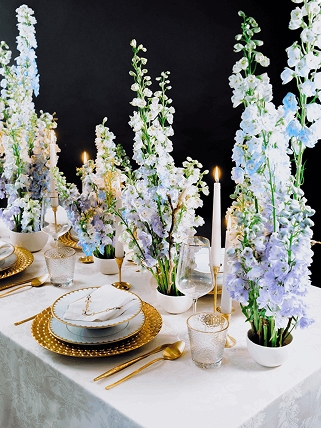
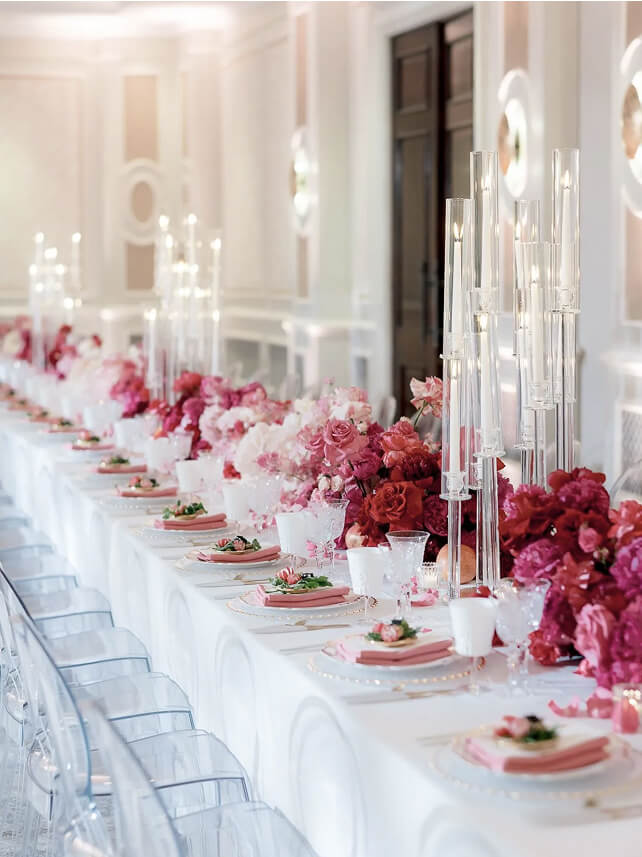
Guests spend a significant portion of the reception seated at their tables — the centrepiece is what they look at, photograph, and remember. The design can range from a tight posy in a single vessel to a low runner that stretches the length of the table, and the style should follow your broader theme rather than compete with it.
Scale matters practically as well as aesthetically: arrangements that sit too tall or too wide make conversation difficult across the table. A neutral tablecloth gives you more freedom with flower colour; varying vessel heights across a table adds structure and visual movement without requiring multiple arrangement styles.
Scale matters practically as well as aesthetically: arrangements that sit too tall or too wide make conversation difficult across the table. A neutral tablecloth gives you more freedom with flower colour; varying vessel heights across a table adds structure and visual movement without requiring multiple arrangement styles.
4. Flower wall
A floor-to-ceiling flower wall is one of the most impactful installations available — a backdrop that works for the vow exchange, the reception, and the photographs in equal measure. It brings an outdoor quality into interior spaces and tends to become the most photographed element of the day.
Flower walls don’t need to be densely packed to be effective. Incorporating vines and open foliage creates a lighter, more naturalistic result; attaching individual flowers at varying intervals gives more control over placement and negative space. The backdrop colour itself is also a design decision — a shade that contrasts with or deepens the blooms will change how the whole installation reads. An ombré arrangement, where flowers are graded from dark to light in a seamless gradient, is a particularly refined variation on the format.
Flower walls don’t need to be densely packed to be effective. Incorporating vines and open foliage creates a lighter, more naturalistic result; attaching individual flowers at varying intervals gives more control over placement and negative space. The backdrop colour itself is also a design decision — a shade that contrasts with or deepens the blooms will change how the whole installation reads. An ombré arrangement, where flowers are graded from dark to light in a seamless gradient, is a particularly refined variation on the format.
5. Hanging installation
A hanging installation suspends flowers above the table or dance floor — a format that adds scale and drama without occupying any floor or table space. It can be designed to almost any specification: a dense canopy of blooms, a more open structure of trailing foliage and stems, or something in between. Because the installation hangs overhead, it becomes the focal point of the room from any angle, without interfering with sight lines or conversation. A florist or floral designer can advise on what works within the structural constraints of your specific venue.
For more floral inspiration, visit our Pinterest page.
2. Pew end flowers
The ceremony is often where floral decoration receives the least attention, with most effort directed at the reception. Pew end arrangements change that — lining the aisle with flowers creates a considered transition into the space and gives guests something to take in as they arrive and settle.
Tied bunches of blooms at each pew end are the most straightforward approach; floral meadow-style arrangements that appear to grow from the ground offer something less expected. Either way, choosing shades that sit within your overall colour scheme ties the ceremony and reception together as a single visual narrative.
Tied bunches of blooms at each pew end are the most straightforward approach; floral meadow-style arrangements that appear to grow from the ground offer something less expected. Either way, choosing shades that sit within your overall colour scheme ties the ceremony and reception together as a single visual narrative.
Guests spend a significant portion of the reception seated at their tables — the centrepiece is what they look at, photograph, and remember. The design can range from a tight posy in a single vessel to a low runner that stretches the length of the table, and the style should follow your broader theme rather than compete with it.
Scale matters practically as well as aesthetically: arrangements that sit too tall or too wide make conversation difficult across the table. A neutral tablecloth gives you more freedom with flower colour; varying vessel heights across a table adds structure and visual movement without requiring multiple arrangement styles.
Scale matters practically as well as aesthetically: arrangements that sit too tall or too wide make conversation difficult across the table. A neutral tablecloth gives you more freedom with flower colour; varying vessel heights across a table adds structure and visual movement without requiring multiple arrangement styles.
4. Flower wall
A floor-to-ceiling flower wall is one of the most impactful installations available — a backdrop that works for the vow exchange, the reception, and the photographs in equal measure. It brings an outdoor quality into interior spaces and tends to become the most photographed element of the day.
Flower walls don’t need to be densely packed to be effective. Incorporating vines and open foliage creates a lighter, more naturalistic result; attaching individual flowers at varying intervals gives more control over placement and negative space. The backdrop colour itself is also a design decision — a shade that contrasts with or deepens the blooms will change how the whole installation reads. An ombré arrangement, where flowers are graded from dark to light in a seamless gradient, is a particularly refined variation on the format.
Flower walls don’t need to be densely packed to be effective. Incorporating vines and open foliage creates a lighter, more naturalistic result; attaching individual flowers at varying intervals gives more control over placement and negative space. The backdrop colour itself is also a design decision — a shade that contrasts with or deepens the blooms will change how the whole installation reads. An ombré arrangement, where flowers are graded from dark to light in a seamless gradient, is a particularly refined variation on the format.
5. Hanging installation
A hanging installation suspends flowers above the table or dance floor — a format that adds scale and drama without occupying any floor or table space. It can be designed to almost any specification: a dense canopy of blooms, a more open structure of trailing foliage and stems, or something in between. Because the installation hangs overhead, it becomes the focal point of the room from any angle, without interfering with sight lines or conversation. A florist or floral designer can advise on what works within the structural constraints of your specific venue.
For more floral inspiration, visit our Pinterest page.

2. Pew end flowers
The ceremony is often where floral decoration receives the least attention, with most effort directed at the reception. Pew end arrangements change that — lining the aisle with flowers creates a considered transition into the space and gives guests something to take in as they arrive and settle.
Tied bunches of blooms at each pew end are the most straightforward approach; floral meadow-style arrangements that appear to grow from the ground offer something less expected. Either way, choosing shades that sit within your overall colour scheme ties the ceremony and reception together as a single visual narrative.
Tied bunches of blooms at each pew end are the most straightforward approach; floral meadow-style arrangements that appear to grow from the ground offer something less expected. Either way, choosing shades that sit within your overall colour scheme ties the ceremony and reception together as a single visual narrative.
Guests spend a significant portion of the reception seated at their tables — the centrepiece is what they look at, photograph, and remember. The design can range from a tight posy in a single vessel to a low runner that stretches the length of the table, and the style should follow your broader theme rather than compete with it.
Scale matters practically as well as aesthetically: arrangements that sit too tall or too wide make conversation difficult across the table. A neutral tablecloth gives you more freedom with flower colour; varying vessel heights across a table adds structure and visual movement without requiring multiple arrangement styles.
Scale matters practically as well as aesthetically: arrangements that sit too tall or too wide make conversation difficult across the table. A neutral tablecloth gives you more freedom with flower colour; varying vessel heights across a table adds structure and visual movement without requiring multiple arrangement styles.
4. Flower wall
A floor-to-ceiling flower wall is one of the most impactful installations available — a backdrop that works for the vow exchange, the reception, and the photographs in equal measure. It brings an outdoor quality into interior spaces and tends to become the most photographed element of the day.
Flower walls don’t need to be densely packed to be effective. Incorporating vines and open foliage creates a lighter, more naturalistic result; attaching individual flowers at varying intervals gives more control over placement and negative space. The backdrop colour itself is also a design decision — a shade that contrasts with or deepens the blooms will change how the whole installation reads. An ombré arrangement, where flowers are graded from dark to light in a seamless gradient, is a particularly refined variation on the format.
Flower walls don’t need to be densely packed to be effective. Incorporating vines and open foliage creates a lighter, more naturalistic result; attaching individual flowers at varying intervals gives more control over placement and negative space. The backdrop colour itself is also a design decision — a shade that contrasts with or deepens the blooms will change how the whole installation reads. An ombré arrangement, where flowers are graded from dark to light in a seamless gradient, is a particularly refined variation on the format.
5. Hanging installation
A hanging installation suspends flowers above the table or dance floor — a format that adds scale and drama without occupying any floor or table space. It can be designed to almost any specification: a dense canopy of blooms, a more open structure of trailing foliage and stems, or something in between. Because the installation hangs overhead, it becomes the focal point of the room from any angle, without interfering with sight lines or conversation. A florist or floral designer can advise on what works within the structural constraints of your specific venue.
For more floral inspiration, visit our Pinterest page.
1. Floral arches
A floral arch frames the ceremony or reception entrance and doubles as one of the most photographed elements of the day — effective indoors and outdoors, and strong against almost any venue backdrop. Combining brightly coloured blooms with generous greenery tends to give the most striking result, though the style depends entirely on your palette and the character of the space.
A florist can design the arch to match your colour scheme, whether you’re working with a single tone or a layered combination. Dried flowers are a considered alternative to fresh, with a texture and longevity that suits certain aesthetics particularly well. The arch form itself doesn’t need to be conventional — an asymmetrical structure or a moon gate, with its fully circular shape, can be just as compelling.
A florist can design the arch to match your colour scheme, whether you’re working with a single tone or a layered combination. Dried flowers are a considered alternative to fresh, with a texture and longevity that suits certain aesthetics particularly well. The arch form itself doesn’t need to be conventional — an asymmetrical structure or a moon gate, with its fully circular shape, can be just as compelling.
2. Pew end flowers
The ceremony is often where floral decoration receives the least attention, with most effort directed at the reception. Pew end arrangements change that — lining the aisle with flowers creates a considered transition into the space and gives guests something to take in as they arrive and settle.
Tied bunches of blooms at each pew end are the most straightforward approach; floral meadow-style arrangements that appear to grow from the ground offer something less expected. Either way, choosing shades that sit within your overall colour scheme ties the ceremony and reception together as a single visual narrative.
Tied bunches of blooms at each pew end are the most straightforward approach; floral meadow-style arrangements that appear to grow from the ground offer something less expected. Either way, choosing shades that sit within your overall colour scheme ties the ceremony and reception together as a single visual narrative.
Guests spend a significant portion of the reception seated at their tables — the centrepiece is what they look at, photograph, and remember. The design can range from a tight posy in a single vessel to a low runner that stretches the length of the table, and the style should follow your broader theme rather than compete with it.
Scale matters practically as well as aesthetically: arrangements that sit too tall or too wide make conversation difficult across the table. A neutral tablecloth gives you more freedom with flower colour; varying vessel heights across a table adds structure and visual movement without requiring multiple arrangement styles.
Scale matters practically as well as aesthetically: arrangements that sit too tall or too wide make conversation difficult across the table. A neutral tablecloth gives you more freedom with flower colour; varying vessel heights across a table adds structure and visual movement without requiring multiple arrangement styles.
4. Flower wall
A floor-to-ceiling flower wall is one of the most impactful installations available — a backdrop that works for the vow exchange, the reception, and the photographs in equal measure. It brings an outdoor quality into interior spaces and tends to become the most photographed element of the day.
Flower walls don’t need to be densely packed to be effective. Incorporating vines and open foliage creates a lighter, more naturalistic result; attaching individual flowers at varying intervals gives more control over placement and negative space. The backdrop colour itself is also a design decision — a shade that contrasts with or deepens the blooms will change how the whole installation reads. An ombré arrangement, where flowers are graded from dark to light in a seamless gradient, is a particularly refined variation on the format.
Flower walls don’t need to be densely packed to be effective. Incorporating vines and open foliage creates a lighter, more naturalistic result; attaching individual flowers at varying intervals gives more control over placement and negative space. The backdrop colour itself is also a design decision — a shade that contrasts with or deepens the blooms will change how the whole installation reads. An ombré arrangement, where flowers are graded from dark to light in a seamless gradient, is a particularly refined variation on the format.
5. Hanging installation
A hanging installation suspends flowers above the table or dance floor — a format that adds scale and drama without occupying any floor or table space. It can be designed to almost any specification: a dense canopy of blooms, a more open structure of trailing foliage and stems, or something in between. Because the installation hangs overhead, it becomes the focal point of the room from any angle, without interfering with sight lines or conversation. A florist or floral designer can advise on what works within the structural constraints of your specific venue.
For more floral inspiration, visit our Pinterest page.
Floral Decoration Ideas
1. Floral arches
A floral arch frames the ceremony or reception entrance and doubles as one of the most photographed elements of the day — effective indoors and outdoors, and strong against almost any venue backdrop. Combining brightly coloured blooms with generous greenery tends to give the most striking result, though the style depends entirely on your palette and the character of the space.
A florist can design the arch to match your colour scheme, whether you’re working with a single tone or a layered combination. Dried flowers are a considered alternative to fresh, with a texture and longevity that suits certain aesthetics particularly well. The arch form itself doesn’t need to be conventional — an asymmetrical structure or a moon gate, with its fully circular shape, can be just as compelling.
A florist can design the arch to match your colour scheme, whether you’re working with a single tone or a layered combination. Dried flowers are a considered alternative to fresh, with a texture and longevity that suits certain aesthetics particularly well. The arch form itself doesn’t need to be conventional — an asymmetrical structure or a moon gate, with its fully circular shape, can be just as compelling.
2. Pew end flowers
The ceremony is often where floral decoration receives the least attention, with most effort directed at the reception. Pew end arrangements change that — lining the aisle with flowers creates a considered transition into the space and gives guests something to take in as they arrive and settle.
Tied bunches of blooms at each pew end are the most straightforward approach; floral meadow-style arrangements that appear to grow from the ground offer something less expected. Either way, choosing shades that sit within your overall colour scheme ties the ceremony and reception together as a single visual narrative.
Tied bunches of blooms at each pew end are the most straightforward approach; floral meadow-style arrangements that appear to grow from the ground offer something less expected. Either way, choosing shades that sit within your overall colour scheme ties the ceremony and reception together as a single visual narrative.
Guests spend a significant portion of the reception seated at their tables — the centrepiece is what they look at, photograph, and remember. The design can range from a tight posy in a single vessel to a low runner that stretches the length of the table, and the style should follow your broader theme rather than compete with it.
Scale matters practically as well as aesthetically: arrangements that sit too tall or too wide make conversation difficult across the table. A neutral tablecloth gives you more freedom with flower colour; varying vessel heights across a table adds structure and visual movement without requiring multiple arrangement styles.
Scale matters practically as well as aesthetically: arrangements that sit too tall or too wide make conversation difficult across the table. A neutral tablecloth gives you more freedom with flower colour; varying vessel heights across a table adds structure and visual movement without requiring multiple arrangement styles.
4. Flower wall
A floor-to-ceiling flower wall is one of the most impactful installations available — a backdrop that works for the vow exchange, the reception, and the photographs in equal measure. It brings an outdoor quality into interior spaces and tends to become the most photographed element of the day.
Flower walls don’t need to be densely packed to be effective. Incorporating vines and open foliage creates a lighter, more naturalistic result; attaching individual flowers at varying intervals gives more control over placement and negative space. The backdrop colour itself is also a design decision — a shade that contrasts with or deepens the blooms will change how the whole installation reads. An ombré arrangement, where flowers are graded from dark to light in a seamless gradient, is a particularly refined variation on the format.
Flower walls don’t need to be densely packed to be effective. Incorporating vines and open foliage creates a lighter, more naturalistic result; attaching individual flowers at varying intervals gives more control over placement and negative space. The backdrop colour itself is also a design decision — a shade that contrasts with or deepens the blooms will change how the whole installation reads. An ombré arrangement, where flowers are graded from dark to light in a seamless gradient, is a particularly refined variation on the format.
5. Hanging installation
A hanging installation suspends flowers above the table or dance floor — a format that adds scale and drama without occupying any floor or table space. It can be designed to almost any specification: a dense canopy of blooms, a more open structure of trailing foliage and stems, or something in between. Because the installation hangs overhead, it becomes the focal point of the room from any angle, without interfering with sight lines or conversation. A florist or floral designer can advise on what works within the structural constraints of your specific venue.
For more floral inspiration, visit our Pinterest page.
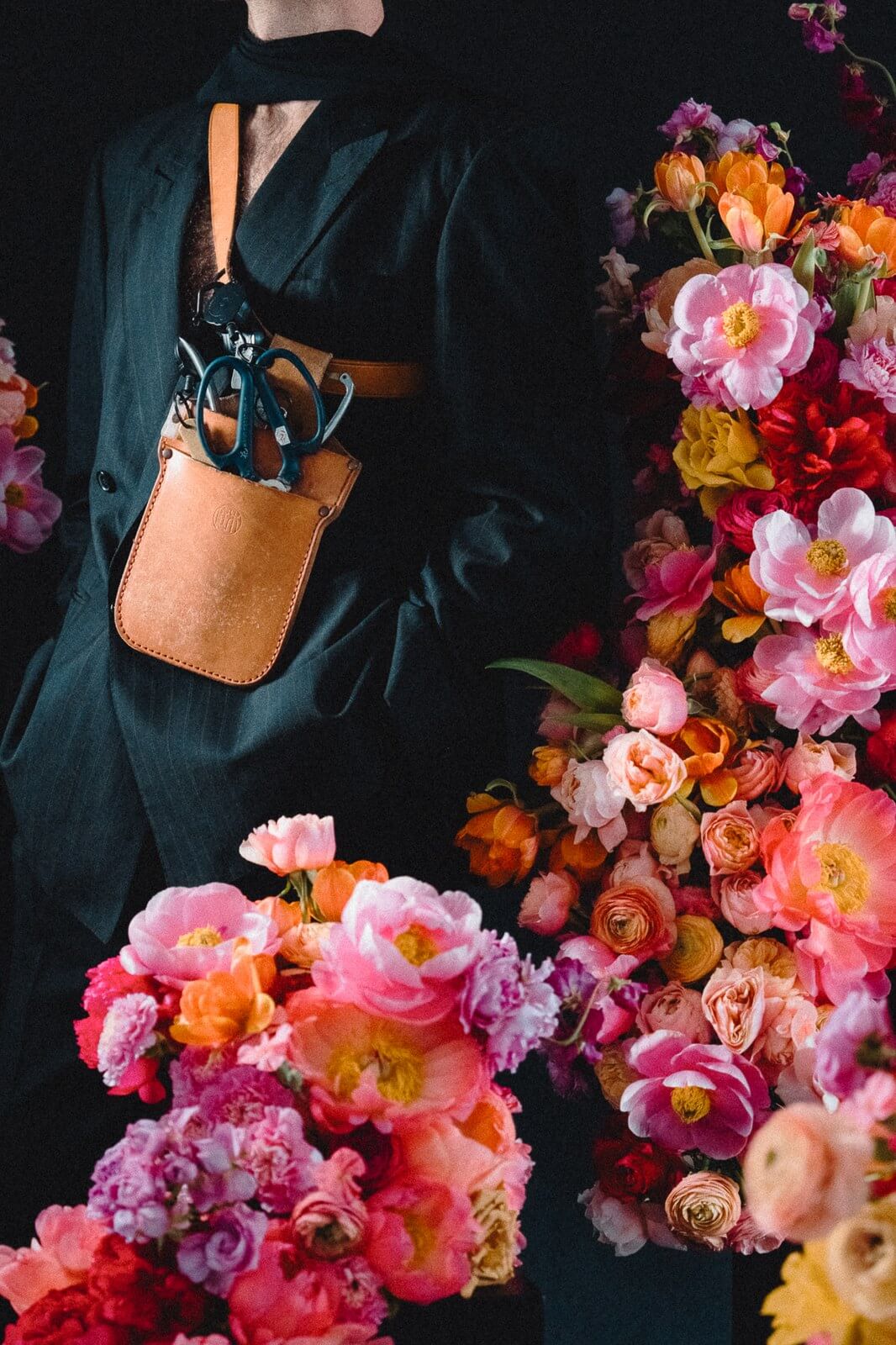
Flowers have featured at weddings for centuries — woven through the ceremony, the reception, and almost every surface in between. But with so many arrangement styles to consider alongside your colour scheme, venue, and seasonal availability, knowing where to begin can feel like a significant task. Here are five floral decoration ideas worth exploring.
Floral Decoration Ideas
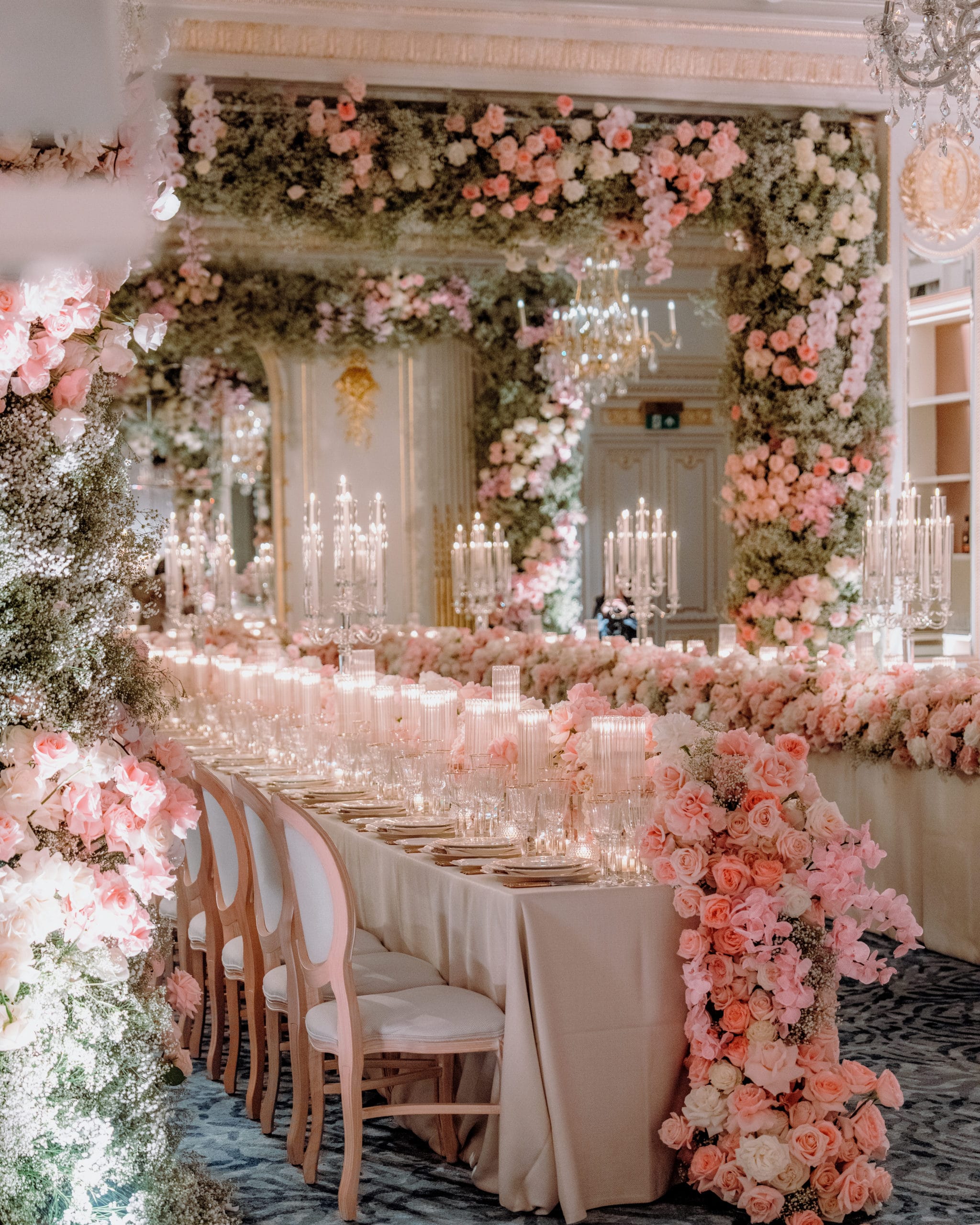
1. Floral arches
A floral arch frames the ceremony or reception entrance and doubles as one of the most photographed elements of the day — effective indoors and outdoors, and strong against almost any venue backdrop. Combining brightly coloured blooms with generous greenery tends to give the most striking result, though the style depends entirely on your palette and the character of the space.
A florist can design the arch to match your colour scheme, whether you’re working with a single tone or a layered combination. Dried flowers are a considered alternative to fresh, with a texture and longevity that suits certain aesthetics particularly well. The arch form itself doesn’t need to be conventional — an asymmetrical structure or a moon gate, with its fully circular shape, can be just as compelling.
A florist can design the arch to match your colour scheme, whether you’re working with a single tone or a layered combination. Dried flowers are a considered alternative to fresh, with a texture and longevity that suits certain aesthetics particularly well. The arch form itself doesn’t need to be conventional — an asymmetrical structure or a moon gate, with its fully circular shape, can be just as compelling.
2. Pew end flowers
The ceremony is often where floral decoration receives the least attention, with most effort directed at the reception. Pew end arrangements change that — lining the aisle with flowers creates a considered transition into the space and gives guests something to take in as they arrive and settle.
Tied bunches of blooms at each pew end are the most straightforward approach; floral meadow-style arrangements that appear to grow from the ground offer something less expected. Either way, choosing shades that sit within your overall colour scheme ties the ceremony and reception together as a single visual narrative.
Tied bunches of blooms at each pew end are the most straightforward approach; floral meadow-style arrangements that appear to grow from the ground offer something less expected. Either way, choosing shades that sit within your overall colour scheme ties the ceremony and reception together as a single visual narrative.
Guests spend a significant portion of the reception seated at their tables — the centrepiece is what they look at, photograph, and remember. The design can range from a tight posy in a single vessel to a low runner that stretches the length of the table, and the style should follow your broader theme rather than compete with it.
Scale matters practically as well as aesthetically: arrangements that sit too tall or too wide make conversation difficult across the table. A neutral tablecloth gives you more freedom with flower colour; varying vessel heights across a table adds structure and visual movement without requiring multiple arrangement styles.
Scale matters practically as well as aesthetically: arrangements that sit too tall or too wide make conversation difficult across the table. A neutral tablecloth gives you more freedom with flower colour; varying vessel heights across a table adds structure and visual movement without requiring multiple arrangement styles.
4. Flower wall
A floor-to-ceiling flower wall is one of the most impactful installations available — a backdrop that works for the vow exchange, the reception, and the photographs in equal measure. It brings an outdoor quality into interior spaces and tends to become the most photographed element of the day.
Flower walls don’t need to be densely packed to be effective. Incorporating vines and open foliage creates a lighter, more naturalistic result; attaching individual flowers at varying intervals gives more control over placement and negative space. The backdrop colour itself is also a design decision — a shade that contrasts with or deepens the blooms will change how the whole installation reads. An ombré arrangement, where flowers are graded from dark to light in a seamless gradient, is a particularly refined variation on the format.
Flower walls don’t need to be densely packed to be effective. Incorporating vines and open foliage creates a lighter, more naturalistic result; attaching individual flowers at varying intervals gives more control over placement and negative space. The backdrop colour itself is also a design decision — a shade that contrasts with or deepens the blooms will change how the whole installation reads. An ombré arrangement, where flowers are graded from dark to light in a seamless gradient, is a particularly refined variation on the format.
5. Hanging installation
A hanging installation suspends flowers above the table or dance floor — a format that adds scale and drama without occupying any floor or table space. It can be designed to almost any specification: a dense canopy of blooms, a more open structure of trailing foliage and stems, or something in between. Because the installation hangs overhead, it becomes the focal point of the room from any angle, without interfering with sight lines or conversation. A florist or floral designer can advise on what works within the structural constraints of your specific venue.
For more floral inspiration, visit our Pinterest page.
You may also like: