


Winter Weddings: What Flowers Are In Season?
Poinsettias
Available throughout December in the UK, poinsettias are a Christmas bloom that works effectively as the focal point of a bouquet. Their rich red bracts read clearly against green foliage, making a simple combination that needs little else.
For more inspiration visit our Pinterest page.
Amaryllis
For December weddings, the amaryllis — with its velvety blossoms, thick stems, and deep red colour — suits a hand-tied bouquet well. Pair with texturally similar flowers like tulips and orchids, and add hypericum berries, which are associated with good luck and warding off ill fortune on wedding days. Sprigs of arborvitae, red berries, and holly complete the seasonal arrangement.
Poinsettias
Available throughout December in the UK, poinsettias are a Christmas bloom that works effectively as the focal point of a bouquet. Their rich red bracts read clearly against green foliage, making a simple combination that needs little else.
For more inspiration visit our Pinterest page.
Carnations
Often underestimated, carnations are one of the more practical choices for a winter wedding: they grow throughout the colder months, come in a wide range of colours, and stay fresh for up to two weeks. Red carnations in particular make a strong focal point — the depth of colour reads well against darker winter foliage and beside neutral blooms.
Amaryllis
For December weddings, the amaryllis — with its velvety blossoms, thick stems, and deep red colour — suits a hand-tied bouquet well. Pair with texturally similar flowers like tulips and orchids, and add hypericum berries, which are associated with good luck and warding off ill fortune on wedding days. Sprigs of arborvitae, red berries, and holly complete the seasonal arrangement.
Poinsettias
Available throughout December in the UK, poinsettias are a Christmas bloom that works effectively as the focal point of a bouquet. Their rich red bracts read clearly against green foliage, making a simple combination that needs little else.
For more inspiration visit our Pinterest page.

Carnations
Often underestimated, carnations are one of the more practical choices for a winter wedding: they grow throughout the colder months, come in a wide range of colours, and stay fresh for up to two weeks. Red carnations in particular make a strong focal point — the depth of colour reads well against darker winter foliage and beside neutral blooms.
Amaryllis
For December weddings, the amaryllis — with its velvety blossoms, thick stems, and deep red colour — suits a hand-tied bouquet well. Pair with texturally similar flowers like tulips and orchids, and add hypericum berries, which are associated with good luck and warding off ill fortune on wedding days. Sprigs of arborvitae, red berries, and holly complete the seasonal arrangement.
Poinsettias
Available throughout December in the UK, poinsettias are a Christmas bloom that works effectively as the focal point of a bouquet. Their rich red bracts read clearly against green foliage, making a simple combination that needs little else.
For more inspiration visit our Pinterest page.
Roses
Roses are a symbol of love and romance and available all year round, which makes them a dependable foundation for any wedding bouquet. In winter, deep reds and purples work particularly well, building jewel-toned arrangements that suit the drama of the season.
Carnations
Often underestimated, carnations are one of the more practical choices for a winter wedding: they grow throughout the colder months, come in a wide range of colours, and stay fresh for up to two weeks. Red carnations in particular make a strong focal point — the depth of colour reads well against darker winter foliage and beside neutral blooms.
Amaryllis
For December weddings, the amaryllis — with its velvety blossoms, thick stems, and deep red colour — suits a hand-tied bouquet well. Pair with texturally similar flowers like tulips and orchids, and add hypericum berries, which are associated with good luck and warding off ill fortune on wedding days. Sprigs of arborvitae, red berries, and holly complete the seasonal arrangement.
Poinsettias
Available throughout December in the UK, poinsettias are a Christmas bloom that works effectively as the focal point of a bouquet. Their rich red bracts read clearly against green foliage, making a simple combination that needs little else.
For more inspiration visit our Pinterest page.
Red, Pink and Purple Flowers
Roses
Roses are a symbol of love and romance and available all year round, which makes them a dependable foundation for any wedding bouquet. In winter, deep reds and purples work particularly well, building jewel-toned arrangements that suit the drama of the season.
Carnations
Often underestimated, carnations are one of the more practical choices for a winter wedding: they grow throughout the colder months, come in a wide range of colours, and stay fresh for up to two weeks. Red carnations in particular make a strong focal point — the depth of colour reads well against darker winter foliage and beside neutral blooms.
Amaryllis
For December weddings, the amaryllis — with its velvety blossoms, thick stems, and deep red colour — suits a hand-tied bouquet well. Pair with texturally similar flowers like tulips and orchids, and add hypericum berries, which are associated with good luck and warding off ill fortune on wedding days. Sprigs of arborvitae, red berries, and holly complete the seasonal arrangement.
Poinsettias
Available throughout December in the UK, poinsettias are a Christmas bloom that works effectively as the focal point of a bouquet. Their rich red bracts read clearly against green foliage, making a simple combination that needs little else.
For more inspiration visit our Pinterest page.
Anemones
Anemones are in season from October through to May, making them one of the most reliable choices for a winter wedding bouquet. Available in many colours, the white variety with jet black centres is particularly effective in a winter palette — pair with snowdrops, silver leaves, and white-tipped pine cones for a cohesive silver and white scheme.
Red, Pink and Purple Flowers
Roses
Roses are a symbol of love and romance and available all year round, which makes them a dependable foundation for any wedding bouquet. In winter, deep reds and purples work particularly well, building jewel-toned arrangements that suit the drama of the season.
Carnations
Often underestimated, carnations are one of the more practical choices for a winter wedding: they grow throughout the colder months, come in a wide range of colours, and stay fresh for up to two weeks. Red carnations in particular make a strong focal point — the depth of colour reads well against darker winter foliage and beside neutral blooms.
Amaryllis
For December weddings, the amaryllis — with its velvety blossoms, thick stems, and deep red colour — suits a hand-tied bouquet well. Pair with texturally similar flowers like tulips and orchids, and add hypericum berries, which are associated with good luck and warding off ill fortune on wedding days. Sprigs of arborvitae, red berries, and holly complete the seasonal arrangement.
Poinsettias
Available throughout December in the UK, poinsettias are a Christmas bloom that works effectively as the focal point of a bouquet. Their rich red bracts read clearly against green foliage, making a simple combination that needs little else.
For more inspiration visit our Pinterest page.
Chrysanthemums
A popular choice for January weddings in particular, chrysanthemums have large, simple heads — somewhere between a pom pom and a daisy — that add volume without weight. Blending several colours and combining with silver brunia berries, frosted pine cones, and blue thistles creates a palette well matched to the winter season.
Anemones
Anemones are in season from October through to May, making them one of the most reliable choices for a winter wedding bouquet. Available in many colours, the white variety with jet black centres is particularly effective in a winter palette — pair with snowdrops, silver leaves, and white-tipped pine cones for a cohesive silver and white scheme.
Red, Pink and Purple Flowers
Roses
Roses are a symbol of love and romance and available all year round, which makes them a dependable foundation for any wedding bouquet. In winter, deep reds and purples work particularly well, building jewel-toned arrangements that suit the drama of the season.
Carnations
Often underestimated, carnations are one of the more practical choices for a winter wedding: they grow throughout the colder months, come in a wide range of colours, and stay fresh for up to two weeks. Red carnations in particular make a strong focal point — the depth of colour reads well against darker winter foliage and beside neutral blooms.
Amaryllis
For December weddings, the amaryllis — with its velvety blossoms, thick stems, and deep red colour — suits a hand-tied bouquet well. Pair with texturally similar flowers like tulips and orchids, and add hypericum berries, which are associated with good luck and warding off ill fortune on wedding days. Sprigs of arborvitae, red berries, and holly complete the seasonal arrangement.
Poinsettias
Available throughout December in the UK, poinsettias are a Christmas bloom that works effectively as the focal point of a bouquet. Their rich red bracts read clearly against green foliage, making a simple combination that needs little else.
For more inspiration visit our Pinterest page.

Chrysanthemums
A popular choice for January weddings in particular, chrysanthemums have large, simple heads — somewhere between a pom pom and a daisy — that add volume without weight. Blending several colours and combining with silver brunia berries, frosted pine cones, and blue thistles creates a palette well matched to the winter season.
Anemones
Anemones are in season from October through to May, making them one of the most reliable choices for a winter wedding bouquet. Available in many colours, the white variety with jet black centres is particularly effective in a winter palette — pair with snowdrops, silver leaves, and white-tipped pine cones for a cohesive silver and white scheme.
Red, Pink and Purple Flowers
Roses
Roses are a symbol of love and romance and available all year round, which makes them a dependable foundation for any wedding bouquet. In winter, deep reds and purples work particularly well, building jewel-toned arrangements that suit the drama of the season.
Carnations
Often underestimated, carnations are one of the more practical choices for a winter wedding: they grow throughout the colder months, come in a wide range of colours, and stay fresh for up to two weeks. Red carnations in particular make a strong focal point — the depth of colour reads well against darker winter foliage and beside neutral blooms.
Amaryllis
For December weddings, the amaryllis — with its velvety blossoms, thick stems, and deep red colour — suits a hand-tied bouquet well. Pair with texturally similar flowers like tulips and orchids, and add hypericum berries, which are associated with good luck and warding off ill fortune on wedding days. Sprigs of arborvitae, red berries, and holly complete the seasonal arrangement.
Poinsettias
Available throughout December in the UK, poinsettias are a Christmas bloom that works effectively as the focal point of a bouquet. Their rich red bracts read clearly against green foliage, making a simple combination that needs little else.
For more inspiration visit our Pinterest page.
Baby’s breath
Baby’s breath is an inexpensive winter bloom that works well beyond the filler role it is often assigned. Its small, cloud-like clusters lighten a bouquet and translate equally well into table centrepieces, aisle decorations, and boutonnieres.
Chrysanthemums
A popular choice for January weddings in particular, chrysanthemums have large, simple heads — somewhere between a pom pom and a daisy — that add volume without weight. Blending several colours and combining with silver brunia berries, frosted pine cones, and blue thistles creates a palette well matched to the winter season.
Anemones
Anemones are in season from October through to May, making them one of the most reliable choices for a winter wedding bouquet. Available in many colours, the white variety with jet black centres is particularly effective in a winter palette — pair with snowdrops, silver leaves, and white-tipped pine cones for a cohesive silver and white scheme.
Red, Pink and Purple Flowers
Roses
Roses are a symbol of love and romance and available all year round, which makes them a dependable foundation for any wedding bouquet. In winter, deep reds and purples work particularly well, building jewel-toned arrangements that suit the drama of the season.
Carnations
Often underestimated, carnations are one of the more practical choices for a winter wedding: they grow throughout the colder months, come in a wide range of colours, and stay fresh for up to two weeks. Red carnations in particular make a strong focal point — the depth of colour reads well against darker winter foliage and beside neutral blooms.
Amaryllis
For December weddings, the amaryllis — with its velvety blossoms, thick stems, and deep red colour — suits a hand-tied bouquet well. Pair with texturally similar flowers like tulips and orchids, and add hypericum berries, which are associated with good luck and warding off ill fortune on wedding days. Sprigs of arborvitae, red berries, and holly complete the seasonal arrangement.
Poinsettias
Available throughout December in the UK, poinsettias are a Christmas bloom that works effectively as the focal point of a bouquet. Their rich red bracts read clearly against green foliage, making a simple combination that needs little else.
For more inspiration visit our Pinterest page.
Camellias
Camellias are a winter favourite. These large blooms are sturdy yet delicate, with layered petals that add texture to a bouquet. They reach their peak in early winter, making them well suited to late-year weddings. A white variety works well as the main bloom of a winter bridal arrangement.
Baby’s breath
Baby’s breath is an inexpensive winter bloom that works well beyond the filler role it is often assigned. Its small, cloud-like clusters lighten a bouquet and translate equally well into table centrepieces, aisle decorations, and boutonnieres.
Chrysanthemums
A popular choice for January weddings in particular, chrysanthemums have large, simple heads — somewhere between a pom pom and a daisy — that add volume without weight. Blending several colours and combining with silver brunia berries, frosted pine cones, and blue thistles creates a palette well matched to the winter season.
Anemones
Anemones are in season from October through to May, making them one of the most reliable choices for a winter wedding bouquet. Available in many colours, the white variety with jet black centres is particularly effective in a winter palette — pair with snowdrops, silver leaves, and white-tipped pine cones for a cohesive silver and white scheme.
Red, Pink and Purple Flowers
Roses
Roses are a symbol of love and romance and available all year round, which makes them a dependable foundation for any wedding bouquet. In winter, deep reds and purples work particularly well, building jewel-toned arrangements that suit the drama of the season.
Carnations
Often underestimated, carnations are one of the more practical choices for a winter wedding: they grow throughout the colder months, come in a wide range of colours, and stay fresh for up to two weeks. Red carnations in particular make a strong focal point — the depth of colour reads well against darker winter foliage and beside neutral blooms.
Amaryllis
For December weddings, the amaryllis — with its velvety blossoms, thick stems, and deep red colour — suits a hand-tied bouquet well. Pair with texturally similar flowers like tulips and orchids, and add hypericum berries, which are associated with good luck and warding off ill fortune on wedding days. Sprigs of arborvitae, red berries, and holly complete the seasonal arrangement.
Poinsettias
Available throughout December in the UK, poinsettias are a Christmas bloom that works effectively as the focal point of a bouquet. Their rich red bracts read clearly against green foliage, making a simple combination that needs little else.
For more inspiration visit our Pinterest page.
White, Cream and Pale Flowers
Camellias
Camellias are a winter favourite. These large blooms are sturdy yet delicate, with layered petals that add texture to a bouquet. They reach their peak in early winter, making them well suited to late-year weddings. A white variety works well as the main bloom of a winter bridal arrangement.
Baby’s breath
Baby’s breath is an inexpensive winter bloom that works well beyond the filler role it is often assigned. Its small, cloud-like clusters lighten a bouquet and translate equally well into table centrepieces, aisle decorations, and boutonnieres.
Chrysanthemums
A popular choice for January weddings in particular, chrysanthemums have large, simple heads — somewhere between a pom pom and a daisy — that add volume without weight. Blending several colours and combining with silver brunia berries, frosted pine cones, and blue thistles creates a palette well matched to the winter season.
Anemones
Anemones are in season from October through to May, making them one of the most reliable choices for a winter wedding bouquet. Available in many colours, the white variety with jet black centres is particularly effective in a winter palette — pair with snowdrops, silver leaves, and white-tipped pine cones for a cohesive silver and white scheme.
Red, Pink and Purple Flowers
Roses
Roses are a symbol of love and romance and available all year round, which makes them a dependable foundation for any wedding bouquet. In winter, deep reds and purples work particularly well, building jewel-toned arrangements that suit the drama of the season.
Carnations
Often underestimated, carnations are one of the more practical choices for a winter wedding: they grow throughout the colder months, come in a wide range of colours, and stay fresh for up to two weeks. Red carnations in particular make a strong focal point — the depth of colour reads well against darker winter foliage and beside neutral blooms.
Amaryllis
For December weddings, the amaryllis — with its velvety blossoms, thick stems, and deep red colour — suits a hand-tied bouquet well. Pair with texturally similar flowers like tulips and orchids, and add hypericum berries, which are associated with good luck and warding off ill fortune on wedding days. Sprigs of arborvitae, red berries, and holly complete the seasonal arrangement.
Poinsettias
Available throughout December in the UK, poinsettias are a Christmas bloom that works effectively as the focal point of a bouquet. Their rich red bracts read clearly against green foliage, making a simple combination that needs little else.
For more inspiration visit our Pinterest page.
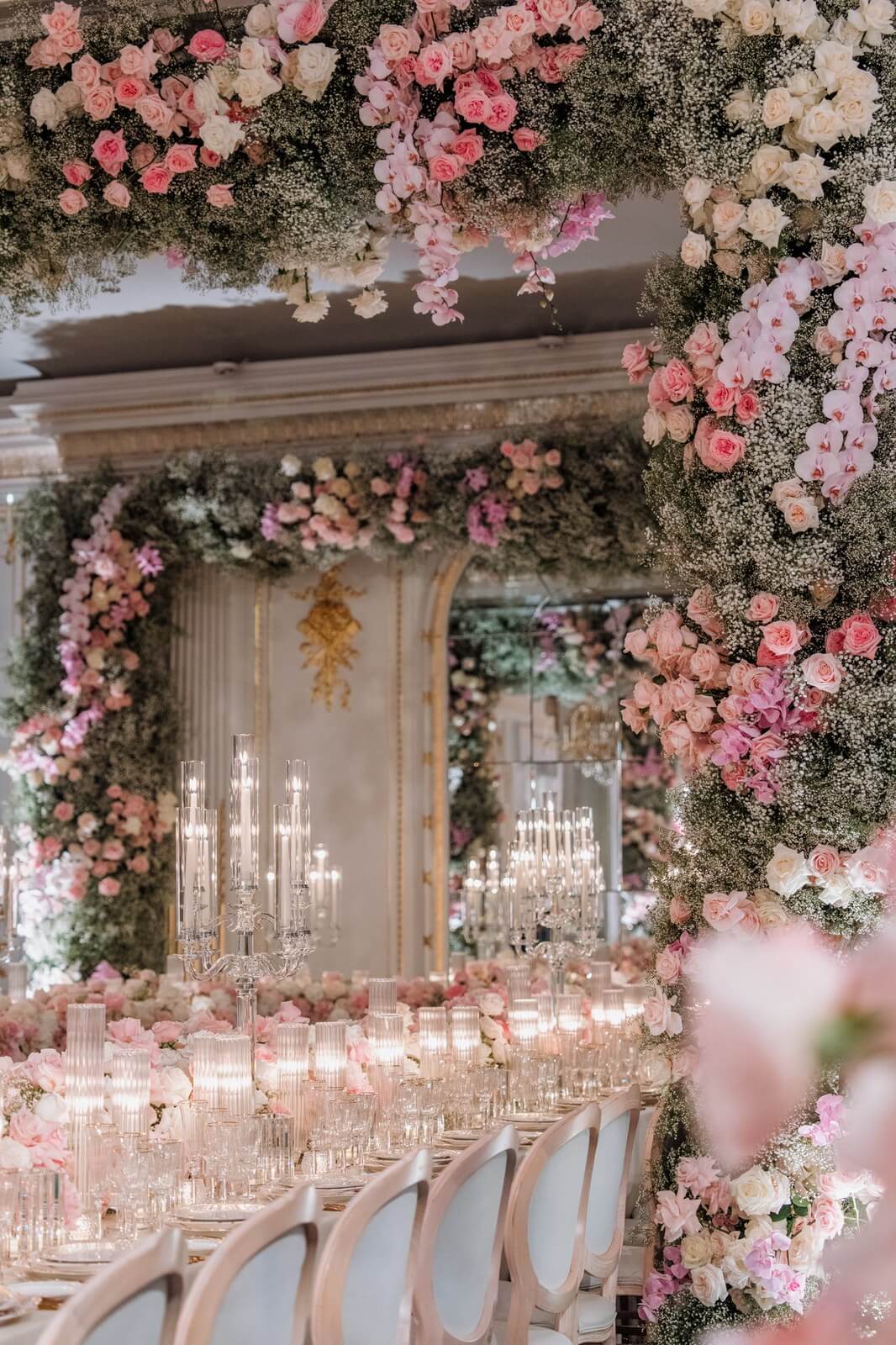
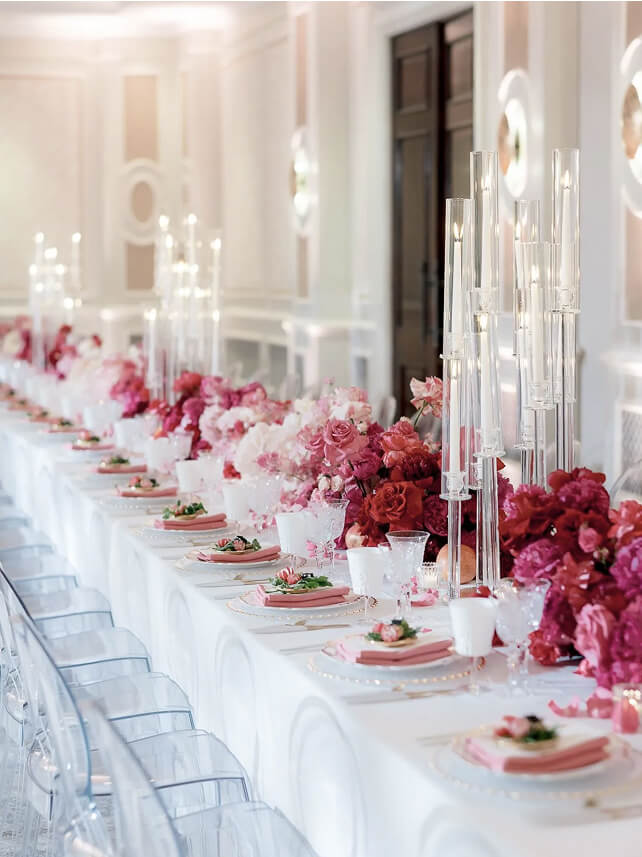
Winter weddings have a character all of their own: candlelight, dark foliage, the possibility of frost on the morning of the ceremony. The season does bring a narrower palette of flowers than spring or summer, but the blooms that do thrive in winter — camellias, anemones, amaryllis — suit the season well. This guide covers which wedding flowers are in season throughout winter and how to use them.
White, Cream and Pale Flowers
Camellias
Camellias are a winter favourite. These large blooms are sturdy yet delicate, with layered petals that add texture to a bouquet. They reach their peak in early winter, making them well suited to late-year weddings. A white variety works well as the main bloom of a winter bridal arrangement.
Baby’s breath
Baby’s breath is an inexpensive winter bloom that works well beyond the filler role it is often assigned. Its small, cloud-like clusters lighten a bouquet and translate equally well into table centrepieces, aisle decorations, and boutonnieres.
Chrysanthemums
A popular choice for January weddings in particular, chrysanthemums have large, simple heads — somewhere between a pom pom and a daisy — that add volume without weight. Blending several colours and combining with silver brunia berries, frosted pine cones, and blue thistles creates a palette well matched to the winter season.
Anemones
Anemones are in season from October through to May, making them one of the most reliable choices for a winter wedding bouquet. Available in many colours, the white variety with jet black centres is particularly effective in a winter palette — pair with snowdrops, silver leaves, and white-tipped pine cones for a cohesive silver and white scheme.
Red, Pink and Purple Flowers
Roses
Roses are a symbol of love and romance and available all year round, which makes them a dependable foundation for any wedding bouquet. In winter, deep reds and purples work particularly well, building jewel-toned arrangements that suit the drama of the season.
Carnations
Often underestimated, carnations are one of the more practical choices for a winter wedding: they grow throughout the colder months, come in a wide range of colours, and stay fresh for up to two weeks. Red carnations in particular make a strong focal point — the depth of colour reads well against darker winter foliage and beside neutral blooms.
Amaryllis
For December weddings, the amaryllis — with its velvety blossoms, thick stems, and deep red colour — suits a hand-tied bouquet well. Pair with texturally similar flowers like tulips and orchids, and add hypericum berries, which are associated with good luck and warding off ill fortune on wedding days. Sprigs of arborvitae, red berries, and holly complete the seasonal arrangement.
Poinsettias
Available throughout December in the UK, poinsettias are a Christmas bloom that works effectively as the focal point of a bouquet. Their rich red bracts read clearly against green foliage, making a simple combination that needs little else.
For more inspiration visit our Pinterest page.
You may also like: