

How To Choose Your Wedding Centrepieces
Take your guests into account
Two practical considerations often overlooked at the design stage are scent and scale. Heavily fragranced flowers can compete with food during a meal, which is worth bearing in mind when selecting varieties for table centrepieces. High-pollen flowers are also worth avoiding for the sake of guests with allergies — lilies, hyacinths, peonies, daffodils and late-summer grasses all tend to carry more pollen than alternatives.
Size matters as much as style. An arrangement that occupies too much of the table surface will restrict the space available for place settings, glasses and serving dishes. A tighter composition of well-chosen blooms will generally read more clearly than one that extends outward with heavy foliage and additional stems.
Size matters as much as style. An arrangement that occupies too much of the table surface will restrict the space available for place settings, glasses and serving dishes. A tighter composition of well-chosen blooms will generally read more clearly than one that extends outward with heavy foliage and additional stems.
For pictures of wedding arrangements, visit our Pinterest account.

Take your guests into account
Two practical considerations often overlooked at the design stage are scent and scale. Heavily fragranced flowers can compete with food during a meal, which is worth bearing in mind when selecting varieties for table centrepieces. High-pollen flowers are also worth avoiding for the sake of guests with allergies — lilies, hyacinths, peonies, daffodils and late-summer grasses all tend to carry more pollen than alternatives.
Size matters as much as style. An arrangement that occupies too much of the table surface will restrict the space available for place settings, glasses and serving dishes. A tighter composition of well-chosen blooms will generally read more clearly than one that extends outward with heavy foliage and additional stems.
Size matters as much as style. An arrangement that occupies too much of the table surface will restrict the space available for place settings, glasses and serving dishes. A tighter composition of well-chosen blooms will generally read more clearly than one that extends outward with heavy foliage and additional stems.
For pictures of wedding arrangements, visit our Pinterest account.
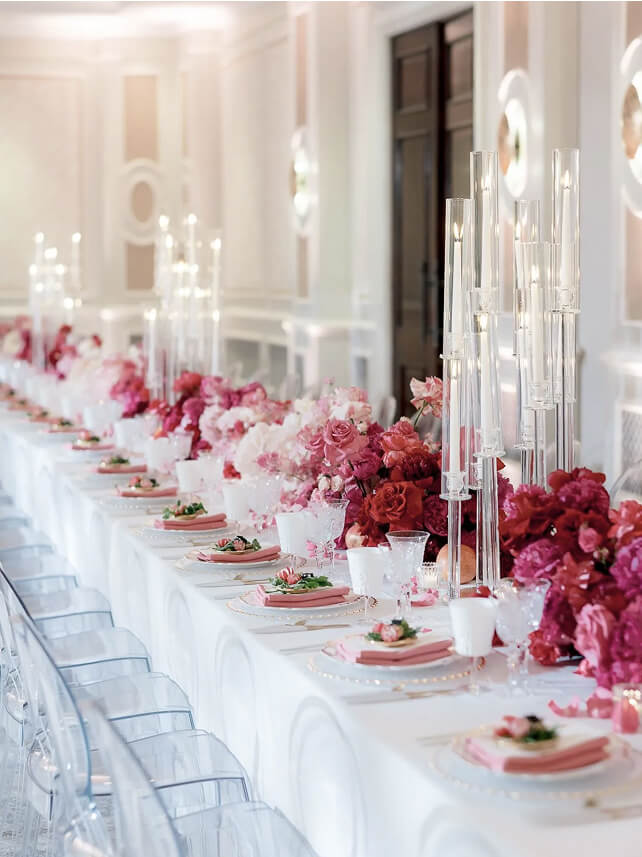
For the primary seating area, keeping to one centrepiece style maintains visual consistency. Secondary tables — the entrance, gifts table, buffet — allow more flexibility.
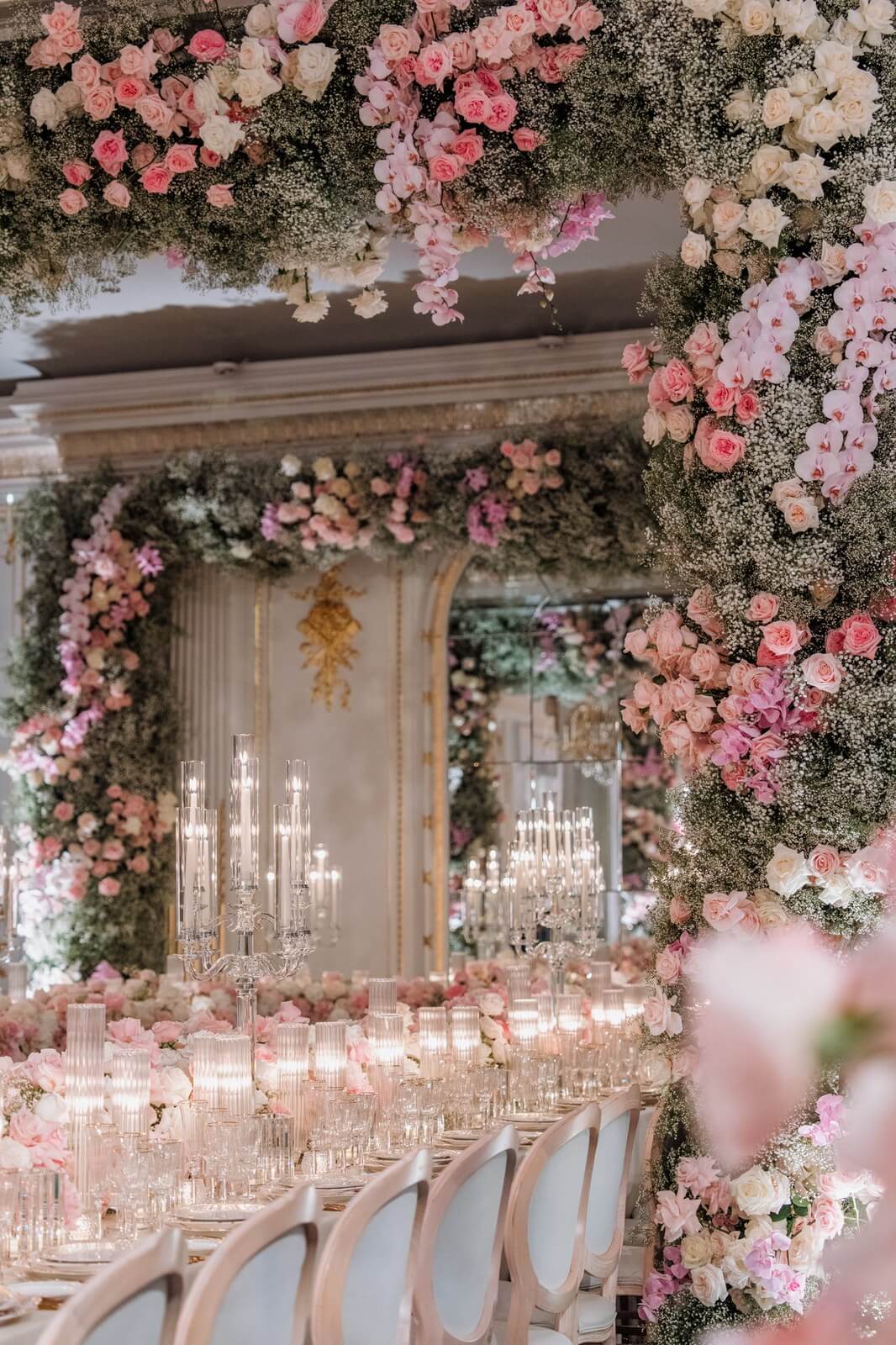
Formation options range from a layered look using different bouquets at varying heights across the venue, to an ombré arrangement where dark tones at the outer ring of each piece fade inward to lighter colours. Contrasting colours, flower types and styles can all work together if the overall scheme holds. An experienced florist can advise on how to achieve the look you have in mind.
Formation options range from a layered look using different bouquets at varying heights across the venue, to an ombré arrangement where dark tones at the outer ring of each piece fade inward to lighter colours. Contrasting colours, flower types and styles can all work together if the overall scheme holds. An experienced florist can advise on how to achieve the look you have in mind.
Take your guests into account
Two practical considerations often overlooked at the design stage are scent and scale. Heavily fragranced flowers can compete with food during a meal, which is worth bearing in mind when selecting varieties for table centrepieces. High-pollen flowers are also worth avoiding for the sake of guests with allergies — lilies, hyacinths, peonies, daffodils and late-summer grasses all tend to carry more pollen than alternatives.
Size matters as much as style. An arrangement that occupies too much of the table surface will restrict the space available for place settings, glasses and serving dishes. A tighter composition of well-chosen blooms will generally read more clearly than one that extends outward with heavy foliage and additional stems.
Size matters as much as style. An arrangement that occupies too much of the table surface will restrict the space available for place settings, glasses and serving dishes. A tighter composition of well-chosen blooms will generally read more clearly than one that extends outward with heavy foliage and additional stems.
For pictures of wedding arrangements, visit our Pinterest account.
Consider your centrepiece style and formation
For the primary seating area, keeping to one centrepiece style maintains visual consistency. Secondary tables — the entrance, gifts table, buffet — allow more flexibility.
Formation options range from a layered look using different bouquets at varying heights across the venue, to an ombré arrangement where dark tones at the outer ring of each piece fade inward to lighter colours. Contrasting colours, flower types and styles can all work together if the overall scheme holds. An experienced florist can advise on how to achieve the look you have in mind.
Formation options range from a layered look using different bouquets at varying heights across the venue, to an ombré arrangement where dark tones at the outer ring of each piece fade inward to lighter colours. Contrasting colours, flower types and styles can all work together if the overall scheme holds. An experienced florist can advise on how to achieve the look you have in mind.
Take your guests into account
Two practical considerations often overlooked at the design stage are scent and scale. Heavily fragranced flowers can compete with food during a meal, which is worth bearing in mind when selecting varieties for table centrepieces. High-pollen flowers are also worth avoiding for the sake of guests with allergies — lilies, hyacinths, peonies, daffodils and late-summer grasses all tend to carry more pollen than alternatives.
Size matters as much as style. An arrangement that occupies too much of the table surface will restrict the space available for place settings, glasses and serving dishes. A tighter composition of well-chosen blooms will generally read more clearly than one that extends outward with heavy foliage and additional stems.
Size matters as much as style. An arrangement that occupies too much of the table surface will restrict the space available for place settings, glasses and serving dishes. A tighter composition of well-chosen blooms will generally read more clearly than one that extends outward with heavy foliage and additional stems.
For pictures of wedding arrangements, visit our Pinterest account.
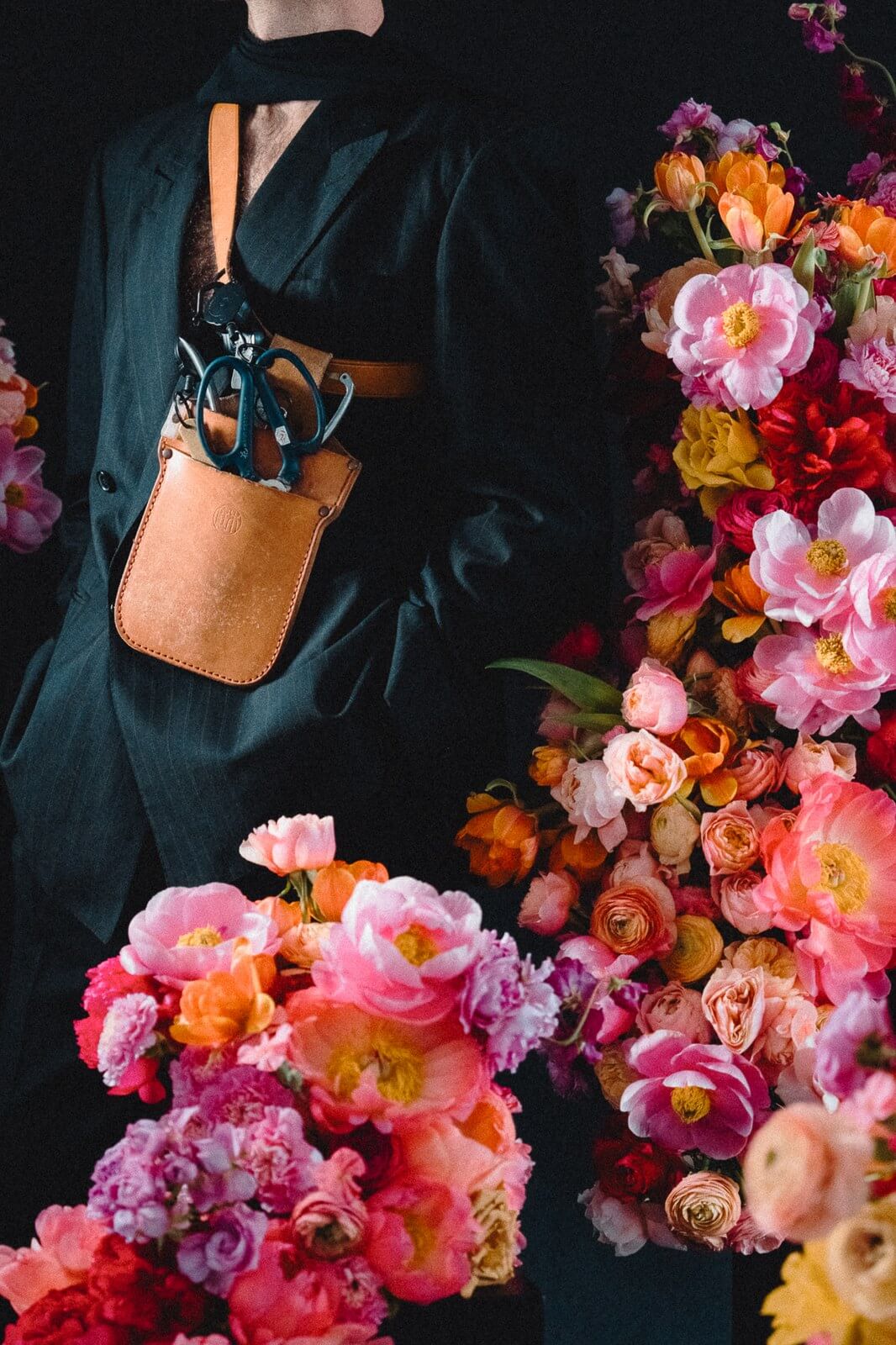
Colour choices need to work within the overall aesthetic of the wedding. Centrepieces that clash with the scheme will undermine everything around them; those that fit too literally can disappear into the background. If you have a defined wedding theme or colour palette, the centrepieces should be considered as part of it from the outset.
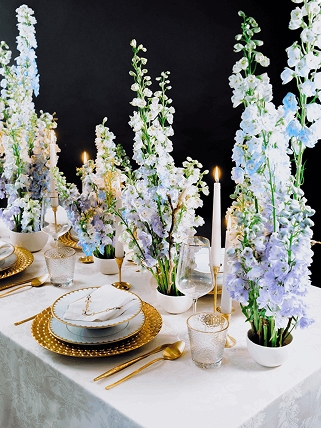
Venue lighting is also a factor. In a dimly lit space, brighter blooms and the addition of candles can provide necessary contrast. Under strong natural or artificial light, vivid colours work better as accents within an arrangement rather than as the dominant element.
Venue lighting is also a factor. In a dimly lit space, brighter blooms and the addition of candles can provide necessary contrast. Under strong natural or artificial light, vivid colours work better as accents within an arrangement rather than as the dominant element.
Consider your centrepiece style and formation
For the primary seating area, keeping to one centrepiece style maintains visual consistency. Secondary tables — the entrance, gifts table, buffet — allow more flexibility.
Formation options range from a layered look using different bouquets at varying heights across the venue, to an ombré arrangement where dark tones at the outer ring of each piece fade inward to lighter colours. Contrasting colours, flower types and styles can all work together if the overall scheme holds. An experienced florist can advise on how to achieve the look you have in mind.
Formation options range from a layered look using different bouquets at varying heights across the venue, to an ombré arrangement where dark tones at the outer ring of each piece fade inward to lighter colours. Contrasting colours, flower types and styles can all work together if the overall scheme holds. An experienced florist can advise on how to achieve the look you have in mind.
Take your guests into account
Two practical considerations often overlooked at the design stage are scent and scale. Heavily fragranced flowers can compete with food during a meal, which is worth bearing in mind when selecting varieties for table centrepieces. High-pollen flowers are also worth avoiding for the sake of guests with allergies — lilies, hyacinths, peonies, daffodils and late-summer grasses all tend to carry more pollen than alternatives.
Size matters as much as style. An arrangement that occupies too much of the table surface will restrict the space available for place settings, glasses and serving dishes. A tighter composition of well-chosen blooms will generally read more clearly than one that extends outward with heavy foliage and additional stems.
Size matters as much as style. An arrangement that occupies too much of the table surface will restrict the space available for place settings, glasses and serving dishes. A tighter composition of well-chosen blooms will generally read more clearly than one that extends outward with heavy foliage and additional stems.
For pictures of wedding arrangements, visit our Pinterest account.
Think carefully about colours
Colour choices need to work within the overall aesthetic of the wedding. Centrepieces that clash with the scheme will undermine everything around them; those that fit too literally can disappear into the background. If you have a defined wedding theme or colour palette, the centrepieces should be considered as part of it from the outset.
Venue lighting is also a factor. In a dimly lit space, brighter blooms and the addition of candles can provide necessary contrast. Under strong natural or artificial light, vivid colours work better as accents within an arrangement rather than as the dominant element.
Venue lighting is also a factor. In a dimly lit space, brighter blooms and the addition of candles can provide necessary contrast. Under strong natural or artificial light, vivid colours work better as accents within an arrangement rather than as the dominant element.
Consider your centrepiece style and formation
For the primary seating area, keeping to one centrepiece style maintains visual consistency. Secondary tables — the entrance, gifts table, buffet — allow more flexibility.
Formation options range from a layered look using different bouquets at varying heights across the venue, to an ombré arrangement where dark tones at the outer ring of each piece fade inward to lighter colours. Contrasting colours, flower types and styles can all work together if the overall scheme holds. An experienced florist can advise on how to achieve the look you have in mind.
Formation options range from a layered look using different bouquets at varying heights across the venue, to an ombré arrangement where dark tones at the outer ring of each piece fade inward to lighter colours. Contrasting colours, flower types and styles can all work together if the overall scheme holds. An experienced florist can advise on how to achieve the look you have in mind.
Take your guests into account
Two practical considerations often overlooked at the design stage are scent and scale. Heavily fragranced flowers can compete with food during a meal, which is worth bearing in mind when selecting varieties for table centrepieces. High-pollen flowers are also worth avoiding for the sake of guests with allergies — lilies, hyacinths, peonies, daffodils and late-summer grasses all tend to carry more pollen than alternatives.
Size matters as much as style. An arrangement that occupies too much of the table surface will restrict the space available for place settings, glasses and serving dishes. A tighter composition of well-chosen blooms will generally read more clearly than one that extends outward with heavy foliage and additional stems.
Size matters as much as style. An arrangement that occupies too much of the table surface will restrict the space available for place settings, glasses and serving dishes. A tighter composition of well-chosen blooms will generally read more clearly than one that extends outward with heavy foliage and additional stems.
For pictures of wedding arrangements, visit our Pinterest account.
Think carefully about colours
Colour choices need to work within the overall aesthetic of the wedding. Centrepieces that clash with the scheme will undermine everything around them; those that fit too literally can disappear into the background. If you have a defined wedding theme or colour palette, the centrepieces should be considered as part of it from the outset.
Venue lighting is also a factor. In a dimly lit space, brighter blooms and the addition of candles can provide necessary contrast. Under strong natural or artificial light, vivid colours work better as accents within an arrangement rather than as the dominant element.
Venue lighting is also a factor. In a dimly lit space, brighter blooms and the addition of candles can provide necessary contrast. Under strong natural or artificial light, vivid colours work better as accents within an arrangement rather than as the dominant element.
Consider your centrepiece style and formation
For the primary seating area, keeping to one centrepiece style maintains visual consistency. Secondary tables — the entrance, gifts table, buffet — allow more flexibility.
Formation options range from a layered look using different bouquets at varying heights across the venue, to an ombré arrangement where dark tones at the outer ring of each piece fade inward to lighter colours. Contrasting colours, flower types and styles can all work together if the overall scheme holds. An experienced florist can advise on how to achieve the look you have in mind.
Formation options range from a layered look using different bouquets at varying heights across the venue, to an ombré arrangement where dark tones at the outer ring of each piece fade inward to lighter colours. Contrasting colours, flower types and styles can all work together if the overall scheme holds. An experienced florist can advise on how to achieve the look you have in mind.
Take your guests into account
Two practical considerations often overlooked at the design stage are scent and scale. Heavily fragranced flowers can compete with food during a meal, which is worth bearing in mind when selecting varieties for table centrepieces. High-pollen flowers are also worth avoiding for the sake of guests with allergies — lilies, hyacinths, peonies, daffodils and late-summer grasses all tend to carry more pollen than alternatives.
Size matters as much as style. An arrangement that occupies too much of the table surface will restrict the space available for place settings, glasses and serving dishes. A tighter composition of well-chosen blooms will generally read more clearly than one that extends outward with heavy foliage and additional stems.
Size matters as much as style. An arrangement that occupies too much of the table surface will restrict the space available for place settings, glasses and serving dishes. A tighter composition of well-chosen blooms will generally read more clearly than one that extends outward with heavy foliage and additional stems.
For pictures of wedding arrangements, visit our Pinterest account.
Which flowers you buy, and how many will make up each centrepiece, will be determined by your budget. Working out the total flower spend requires counting all the tables in the reception — not just seating, but also the entrance, gifts table and any buffet area — and multiplying accordingly. You will also need to consider the shape and size of each table: will a single central arrangement be sufficient, or will larger tables need more than one?
How the budget is distributed across different areas is a matter of priorities. Spending less on guest table centrepieces leaves more for a statement entrance arrangement, while reducing the total number of tables also frees up spend. Using seasonal flowers rather than importing varieties is consistently the most cost-effective approach. For autumn wedding centrepieces, dahlias or roses work well; for spring, freesias or lilacs are natural choices.
How the budget is distributed across different areas is a matter of priorities. Spending less on guest table centrepieces leaves more for a statement entrance arrangement, while reducing the total number of tables also frees up spend. Using seasonal flowers rather than importing varieties is consistently the most cost-effective approach. For autumn wedding centrepieces, dahlias or roses work well; for spring, freesias or lilacs are natural choices.
Think carefully about colours
Colour choices need to work within the overall aesthetic of the wedding. Centrepieces that clash with the scheme will undermine everything around them; those that fit too literally can disappear into the background. If you have a defined wedding theme or colour palette, the centrepieces should be considered as part of it from the outset.
Venue lighting is also a factor. In a dimly lit space, brighter blooms and the addition of candles can provide necessary contrast. Under strong natural or artificial light, vivid colours work better as accents within an arrangement rather than as the dominant element.
Venue lighting is also a factor. In a dimly lit space, brighter blooms and the addition of candles can provide necessary contrast. Under strong natural or artificial light, vivid colours work better as accents within an arrangement rather than as the dominant element.
Consider your centrepiece style and formation
For the primary seating area, keeping to one centrepiece style maintains visual consistency. Secondary tables — the entrance, gifts table, buffet — allow more flexibility.
Formation options range from a layered look using different bouquets at varying heights across the venue, to an ombré arrangement where dark tones at the outer ring of each piece fade inward to lighter colours. Contrasting colours, flower types and styles can all work together if the overall scheme holds. An experienced florist can advise on how to achieve the look you have in mind.
Formation options range from a layered look using different bouquets at varying heights across the venue, to an ombré arrangement where dark tones at the outer ring of each piece fade inward to lighter colours. Contrasting colours, flower types and styles can all work together if the overall scheme holds. An experienced florist can advise on how to achieve the look you have in mind.
Take your guests into account
Two practical considerations often overlooked at the design stage are scent and scale. Heavily fragranced flowers can compete with food during a meal, which is worth bearing in mind when selecting varieties for table centrepieces. High-pollen flowers are also worth avoiding for the sake of guests with allergies — lilies, hyacinths, peonies, daffodils and late-summer grasses all tend to carry more pollen than alternatives.
Size matters as much as style. An arrangement that occupies too much of the table surface will restrict the space available for place settings, glasses and serving dishes. A tighter composition of well-chosen blooms will generally read more clearly than one that extends outward with heavy foliage and additional stems.
Size matters as much as style. An arrangement that occupies too much of the table surface will restrict the space available for place settings, glasses and serving dishes. A tighter composition of well-chosen blooms will generally read more clearly than one that extends outward with heavy foliage and additional stems.
For pictures of wedding arrangements, visit our Pinterest account.
Work out how many centrepieces you need
Which flowers you buy, and how many will make up each centrepiece, will be determined by your budget. Working out the total flower spend requires counting all the tables in the reception — not just seating, but also the entrance, gifts table and any buffet area — and multiplying accordingly. You will also need to consider the shape and size of each table: will a single central arrangement be sufficient, or will larger tables need more than one?
How the budget is distributed across different areas is a matter of priorities. Spending less on guest table centrepieces leaves more for a statement entrance arrangement, while reducing the total number of tables also frees up spend. Using seasonal flowers rather than importing varieties is consistently the most cost-effective approach. For autumn wedding centrepieces, dahlias or roses work well; for spring, freesias or lilacs are natural choices.
How the budget is distributed across different areas is a matter of priorities. Spending less on guest table centrepieces leaves more for a statement entrance arrangement, while reducing the total number of tables also frees up spend. Using seasonal flowers rather than importing varieties is consistently the most cost-effective approach. For autumn wedding centrepieces, dahlias or roses work well; for spring, freesias or lilacs are natural choices.
Think carefully about colours
Colour choices need to work within the overall aesthetic of the wedding. Centrepieces that clash with the scheme will undermine everything around them; those that fit too literally can disappear into the background. If you have a defined wedding theme or colour palette, the centrepieces should be considered as part of it from the outset.
Venue lighting is also a factor. In a dimly lit space, brighter blooms and the addition of candles can provide necessary contrast. Under strong natural or artificial light, vivid colours work better as accents within an arrangement rather than as the dominant element.
Venue lighting is also a factor. In a dimly lit space, brighter blooms and the addition of candles can provide necessary contrast. Under strong natural or artificial light, vivid colours work better as accents within an arrangement rather than as the dominant element.
Consider your centrepiece style and formation
For the primary seating area, keeping to one centrepiece style maintains visual consistency. Secondary tables — the entrance, gifts table, buffet — allow more flexibility.
Formation options range from a layered look using different bouquets at varying heights across the venue, to an ombré arrangement where dark tones at the outer ring of each piece fade inward to lighter colours. Contrasting colours, flower types and styles can all work together if the overall scheme holds. An experienced florist can advise on how to achieve the look you have in mind.
Formation options range from a layered look using different bouquets at varying heights across the venue, to an ombré arrangement where dark tones at the outer ring of each piece fade inward to lighter colours. Contrasting colours, flower types and styles can all work together if the overall scheme holds. An experienced florist can advise on how to achieve the look you have in mind.
Take your guests into account
Two practical considerations often overlooked at the design stage are scent and scale. Heavily fragranced flowers can compete with food during a meal, which is worth bearing in mind when selecting varieties for table centrepieces. High-pollen flowers are also worth avoiding for the sake of guests with allergies — lilies, hyacinths, peonies, daffodils and late-summer grasses all tend to carry more pollen than alternatives.
Size matters as much as style. An arrangement that occupies too much of the table surface will restrict the space available for place settings, glasses and serving dishes. A tighter composition of well-chosen blooms will generally read more clearly than one that extends outward with heavy foliage and additional stems.
Size matters as much as style. An arrangement that occupies too much of the table surface will restrict the space available for place settings, glasses and serving dishes. A tighter composition of well-chosen blooms will generally read more clearly than one that extends outward with heavy foliage and additional stems.
For pictures of wedding arrangements, visit our Pinterest account.
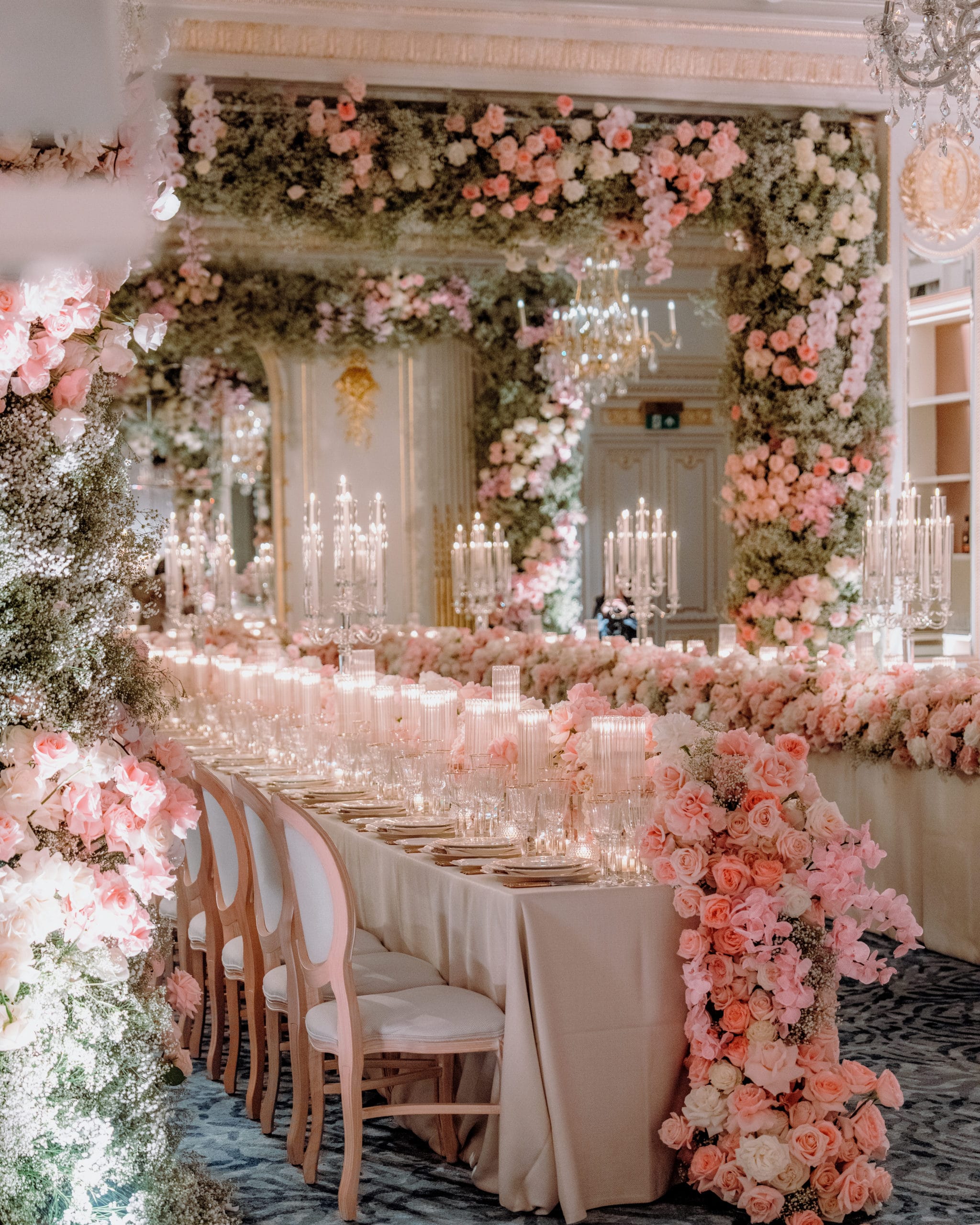
Once the venue is booked, reception planning moves quickly into the details: menu, seating plan, music, cake, and decorations. Among those decorations, the flower centrepieces require particular thought — they need to work with the overall scheme, suit the scale of the space, and function practically for guests seated around them. Here is a guide to planning your wedding centrepieces.
Work out how many centrepieces you need
Which flowers you buy, and how many will make up each centrepiece, will be determined by your budget. Working out the total flower spend requires counting all the tables in the reception — not just seating, but also the entrance, gifts table and any buffet area — and multiplying accordingly. You will also need to consider the shape and size of each table: will a single central arrangement be sufficient, or will larger tables need more than one?
How the budget is distributed across different areas is a matter of priorities. Spending less on guest table centrepieces leaves more for a statement entrance arrangement, while reducing the total number of tables also frees up spend. Using seasonal flowers rather than importing varieties is consistently the most cost-effective approach. For autumn wedding centrepieces, dahlias or roses work well; for spring, freesias or lilacs are natural choices.
How the budget is distributed across different areas is a matter of priorities. Spending less on guest table centrepieces leaves more for a statement entrance arrangement, while reducing the total number of tables also frees up spend. Using seasonal flowers rather than importing varieties is consistently the most cost-effective approach. For autumn wedding centrepieces, dahlias or roses work well; for spring, freesias or lilacs are natural choices.
Think carefully about colours
Colour choices need to work within the overall aesthetic of the wedding. Centrepieces that clash with the scheme will undermine everything around them; those that fit too literally can disappear into the background. If you have a defined wedding theme or colour palette, the centrepieces should be considered as part of it from the outset.
Venue lighting is also a factor. In a dimly lit space, brighter blooms and the addition of candles can provide necessary contrast. Under strong natural or artificial light, vivid colours work better as accents within an arrangement rather than as the dominant element.
Venue lighting is also a factor. In a dimly lit space, brighter blooms and the addition of candles can provide necessary contrast. Under strong natural or artificial light, vivid colours work better as accents within an arrangement rather than as the dominant element.
Consider your centrepiece style and formation
For the primary seating area, keeping to one centrepiece style maintains visual consistency. Secondary tables — the entrance, gifts table, buffet — allow more flexibility.
Formation options range from a layered look using different bouquets at varying heights across the venue, to an ombré arrangement where dark tones at the outer ring of each piece fade inward to lighter colours. Contrasting colours, flower types and styles can all work together if the overall scheme holds. An experienced florist can advise on how to achieve the look you have in mind.
Formation options range from a layered look using different bouquets at varying heights across the venue, to an ombré arrangement where dark tones at the outer ring of each piece fade inward to lighter colours. Contrasting colours, flower types and styles can all work together if the overall scheme holds. An experienced florist can advise on how to achieve the look you have in mind.
Take your guests into account
Two practical considerations often overlooked at the design stage are scent and scale. Heavily fragranced flowers can compete with food during a meal, which is worth bearing in mind when selecting varieties for table centrepieces. High-pollen flowers are also worth avoiding for the sake of guests with allergies — lilies, hyacinths, peonies, daffodils and late-summer grasses all tend to carry more pollen than alternatives.
Size matters as much as style. An arrangement that occupies too much of the table surface will restrict the space available for place settings, glasses and serving dishes. A tighter composition of well-chosen blooms will generally read more clearly than one that extends outward with heavy foliage and additional stems.
Size matters as much as style. An arrangement that occupies too much of the table surface will restrict the space available for place settings, glasses and serving dishes. A tighter composition of well-chosen blooms will generally read more clearly than one that extends outward with heavy foliage and additional stems.
For pictures of wedding arrangements, visit our Pinterest account.
You may also like: