Can Cut Flowers Truly Be Sustainable? What We Found at the World’s Largest Flower Auction
Are cut flowers sustainable?
A rose grown in the UK can carry a heavier carbon footprint than one flown in from Amsterdam.
After a week inside the world’s largest flower auction, almost everything we assumed about sustainable sourcing had been rearranged.
But First, Aalsmeer: The Engine Room of Global Floriculture
At Blooming Haus, we source locally wherever we can.
Yet, as a luxury floral design and events studio, international sourcing is a reality we don’t shy away from.
Understanding what the systems we use actually look like, and who operates within them, is part of how we take responsibility for it.
When it comes to better understanding our supply chain, there was no better starting point for us than the clearinghouse through which a significant portion of global cut flower trade passes: Royal FloraHolland in Aalsmeer .
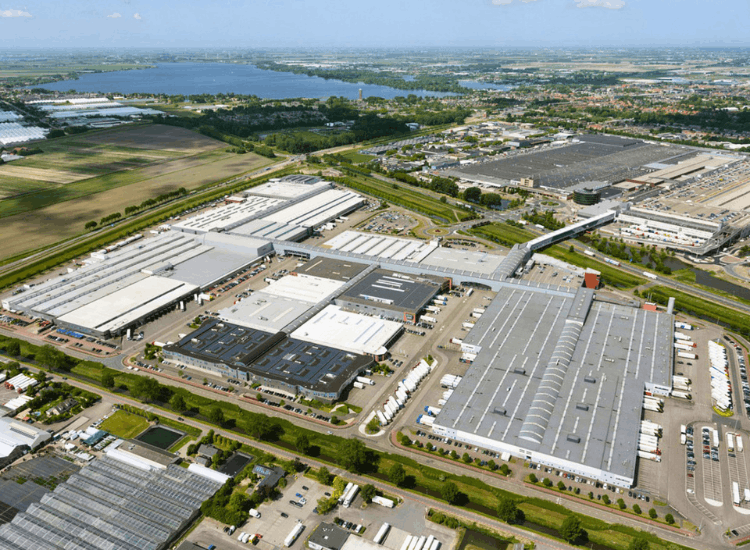
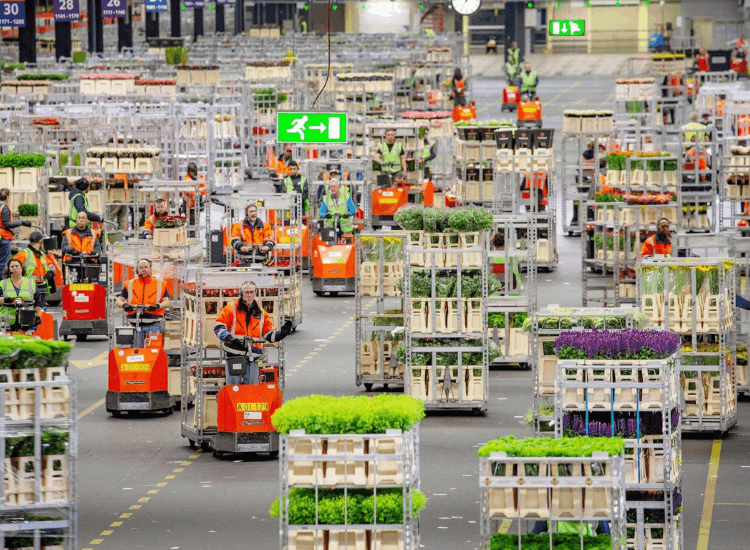
The scale here is difficult to fully absorb.
The Royal FloraHolland Aalsmeer complex is the world’s largest flower auction and one of the largest buildings by floor area, covering approximately 775,000 to 999,000 square meters (>10 million sq ft).
Roughly equivalent to 200 football fields, acting as the main hub for global flower trade.
It handles millions of cut flower stems daily, each spending no more than 48 hours in the building before redistribution worldwide.
The auction runs on a reverse clock system: prices descend in real time, buyers stop the clock to purchase.
It’s a model that has underpinned global floriculture for over a century, connecting farms in the Netherlands, Kenya, Ecuador, and Colombia to markets across Europe, Asia, and North America within hours of harvest.
Connecting With Our Growers
During our visit, we connected with incredible cut flower growers who are rebuilding conventional flower production from the ground up.
Not pilot projects.
Significant commercial operations, already running at scale – and in doing so, raising the standard for everyone else.
1. Fransen Sprayroses – Circular Growing at Scale
Fransen Sprayroses have built a cut flower production system where energy and water efficiency aren’t goals – they’re structural.
- Their greenhouses run on geothermal warmth and solar power
- Water moves through a closed-loop recycling system that eliminates discharge and dramatically reduces consumption per stem
- All green waste is sent to a compost producer
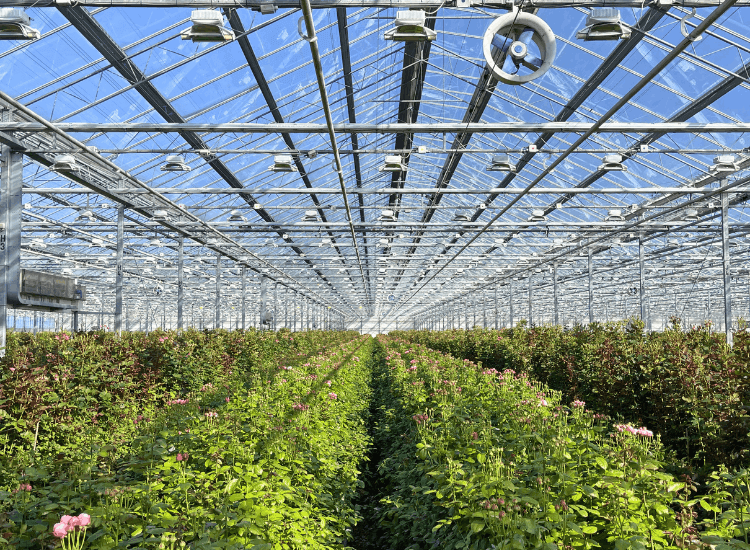
Nothing of value leaves unnecessarily.
The output is an exceptional quality spray rose with what the industry would consider a remarkably light environmental footprint.
2. Seven Orchids – Where Cultivation Meets System Thinking
Seven Orchids grows over 100 varieties of Cymbidium orchid, and does so within a production system designed around minimal inputs and maximum circularity.
- Geothermal heating
- Humidifier-based cooling & emission-free growing floors allow for efficient reuse of water and fertiliser across cycles
- Plants are propagated from existing stock, reducing the resource cost of starting new batches from seed
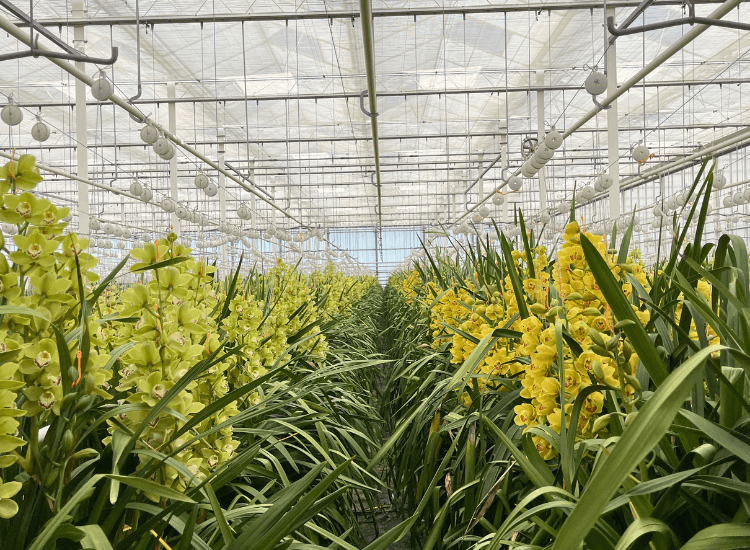
What Seven Orchids represents is a model in which the biological cycle of a plant is the starting point for the operational cycle of the business – rather than something to be managed around it.
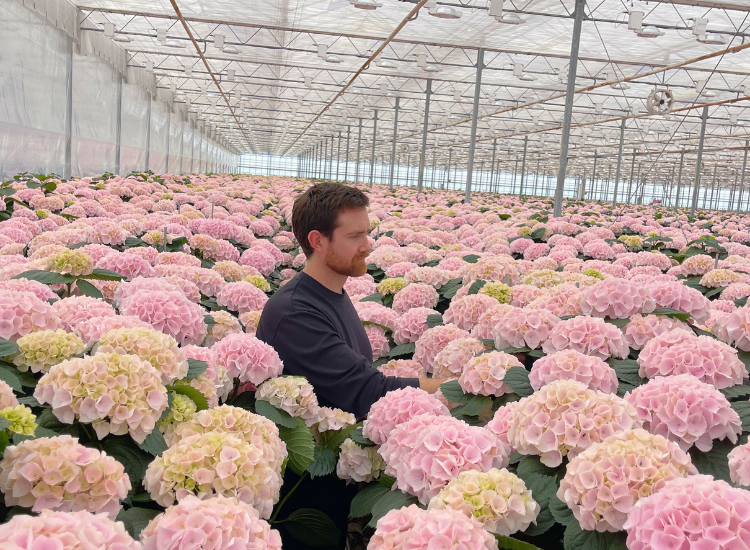
3. Vicini Hydrangeas – Certified. Verifiable. Solar-Powered.
Vicini growing philosophy centres on natural processes – sun and water as the primary drivers of growth, with colour developed through cultivation rather than artificial treatment.
Their greenhouses in De Kwakel are built around that principle.
- Solar panels cover operational energy needs
- All organic waste is composted
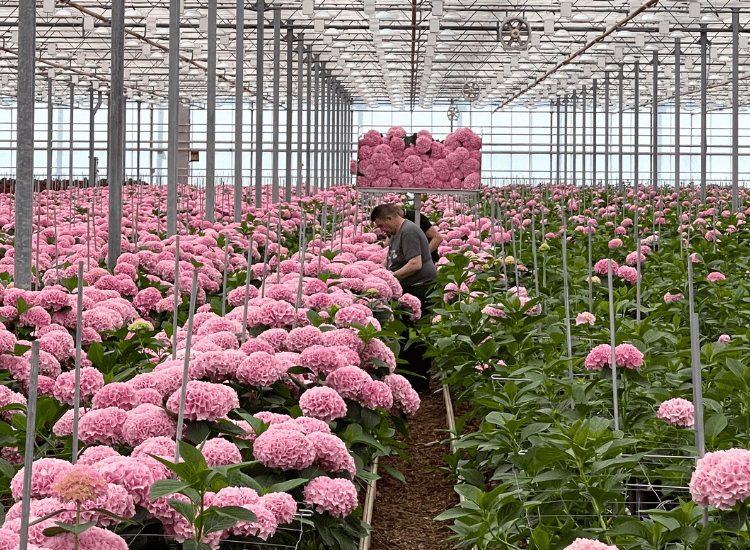
They hold FSI 2025 certification, MPS-A, and MPS-GAP – a certification stack that covers environmental performance, quality management, and good agricultural practice.
At Blooming Haus, we’re also FSI members and use our FSI membership to filter suppliers directly – growers like Vicini are identifiable and prioritisable in our purchasing processes.
The certification infrastructure is not decorative.
It’s functional.
4. Porta Nova – 56g CO₂ Per Stem. Verified.
Porta Nova is the home of the Red Naomi rose, and reports the lowest CO₂ footprint per stem in the industry at 56 grams.
That figure is not marketing, or an isolate claim.
It is the result of a specific, engineered production system.
Find out more here.
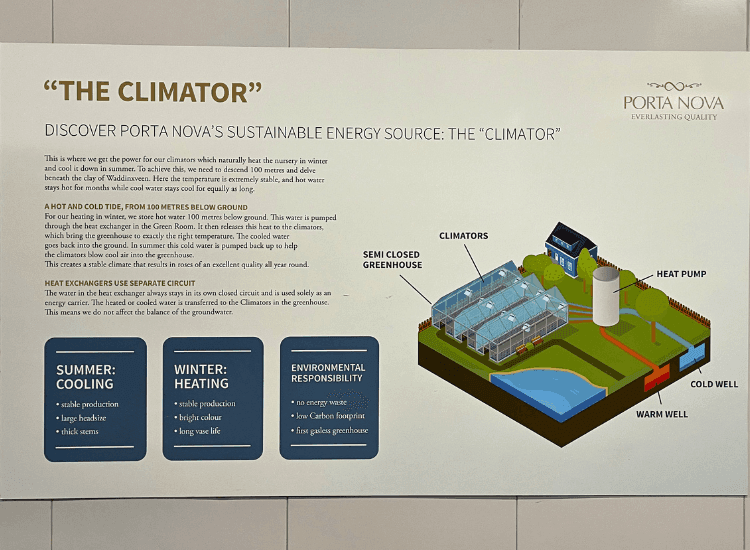
- A Climator System stores summer heat underground and releases it in winter, removing the need for conventional heating
- A private power line supplies 100% wind energy
- LED lighting replaces energy-intensive conventional grow lights
- Biological pest control eliminates pesticide inputs
- Flowers are watered through rainwater that is collected from the roofs and surroundings
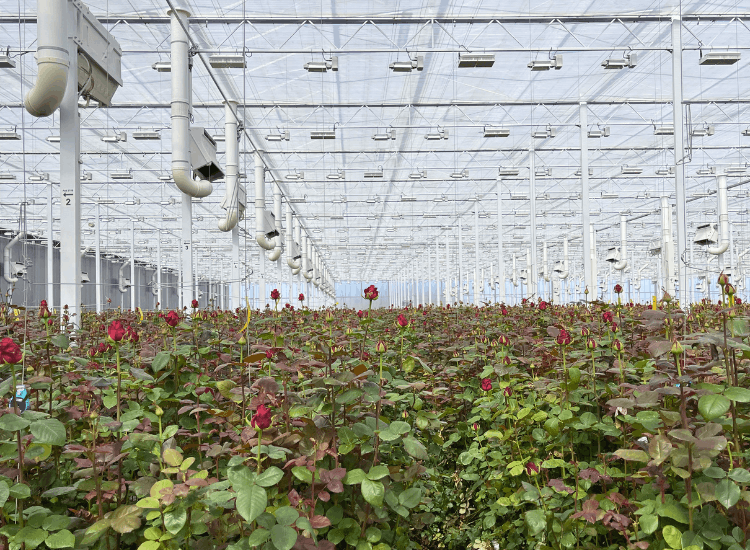
The result: over 200,000 stems produced daily, with a carbon cost per unit that challenges the assumption that scale and sustainability are in tension.
More Than Air Miles
What really hit home on this trip is that with cut flowers, provenance alone doesn’t determine environmental impact.
A rose grown geothermally in the Netherlands, certified to FSI standards, and transported efficiently can carry a lower carbon footprint than one grown domestically in a heated, energy-intensive greenhouse with no sustainability credentials!
The variable that matters isn’t the air miles.
It’s how the flower was grown, and by whom.
And it’s not just environmental.
Communities around the world – in Kenya, Ecuador, Colombia – depend on their flower farms for their livelihoods.
The global cut flower trade, when it works well, supports hundreds of thousands of people.
Sourcing decisions have a social impact as much as an environmental one.
Keukenhof: Seven Million Bulbs and a Six-Century History
We ended our visit at Keukenhof Gardens, where the Tulip Festival Amsterdam was in full season – and where it’s impossible not to feel the weight of what floriculture actually means to people.
What began in the 15th century as a kitchen garden for Countess Jacoba van Beieren now covers 32 hectares and displays 7 million tulip bulbs each spring across eight weeks.
More than a million visitors attend each year.
It’s a tourist destination, a horticultural showcase, a living archive of Dutch flower breeding.
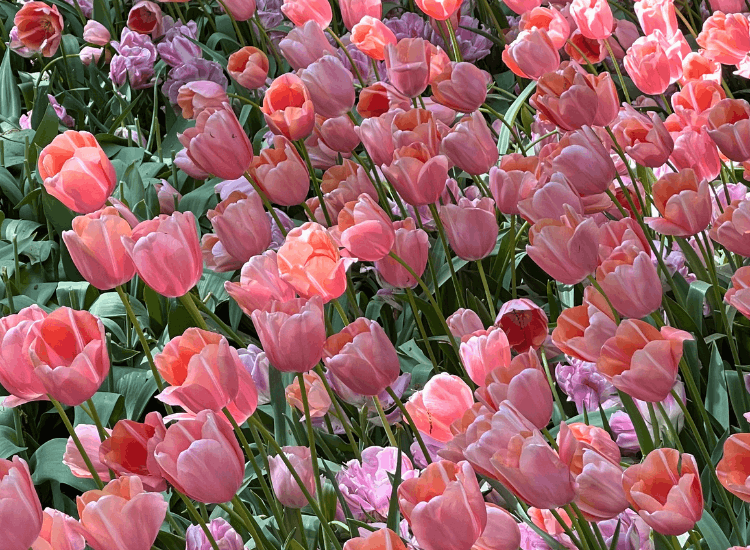
But more than anything, it’s a reminder that the relationship between people and flowers is not new, and not trivial.
It predates industrial agriculture, carbon accounting, and certification frameworks by centuries.
The growers we met that week are part of that same story.
The question now – for them, and for us – is how we protect it, and what we build from it.
Back to the Question: Are Cut Flowers Sustainable?
The honest answer is: it depends entirely on how they are grown, how they travel, and who you ask to account for them.
“A certified stem, sourced through an audited supplier and composted after use, has a fundamentally different footprint from an uncertified stem that ends up in landfill. Treating them as the same product is the mistake..” – Michael Dariane COO at Blooming Haus
The global floral supply chain – running through Aalsmeer, Kenya, Ecuador, and the cold chain logistics moving millions of stems daily – is not one thing, sustainable…or not.
Sourcing is a choice. And it’s important we make it knowingly.
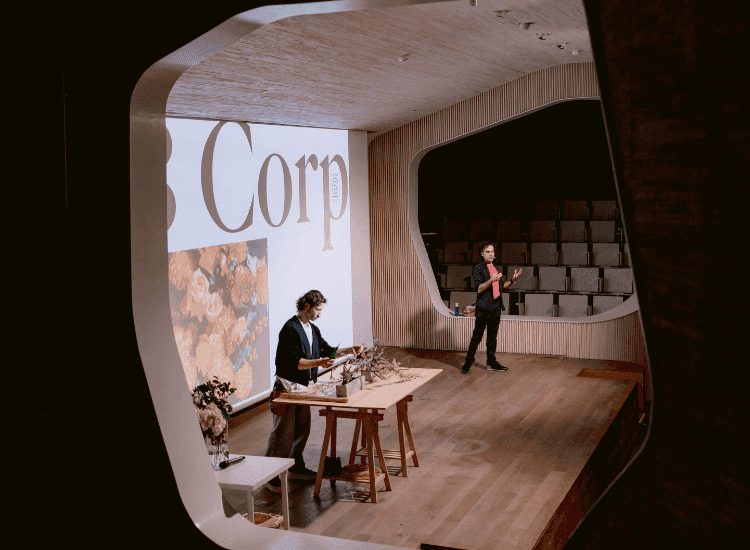
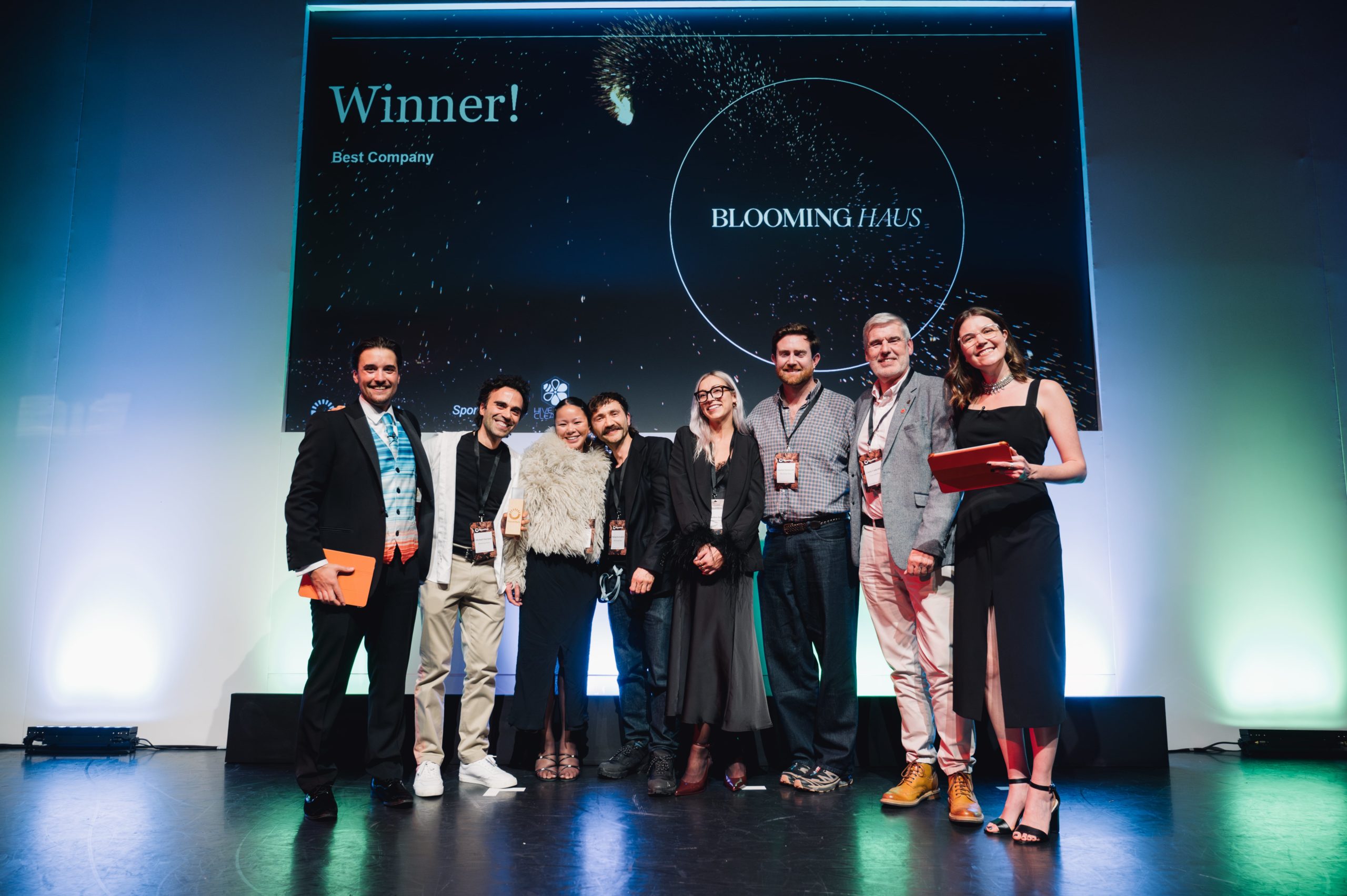
As a Certified B Corp™ and Planet Mark certified floral design & events company, accountability means being honest about where the gaps still are – not just celebrating what’s working.
We’re honest about what we haven’t solved yet.
Our upstream Scope 3 emissions, the carbon embedded in internationally sourced flowers, aren’t yet fully mapped, and full Scope 3 accounting is atarget rather than a current reality.
We’re telling you this because closing a gap starts with naming it.
Visits like Aalsmeer aren’t about reassurance.
They’re about understanding the system we operate within – so we can make better decisions inside it.
Beauty and rigour aren’t in conflict.
At their best, they’re the same thing.
Better Questions, Better Sourcing
Aalsmeer left us humming with life!
That’s the only way to describe it.
Millions of stems moving through one building, crossing borders within hours, touching lives in ways the growers who grew them will never see.
What our visit gave us wasn’t just a clearer picture of the supply chain – it was a reminder of the people inside it.
The growers, the innovators, the businesses quietly building something better without waiting for the industry to catch up.
Sustainability and artistry aren’t opposites in floristry.
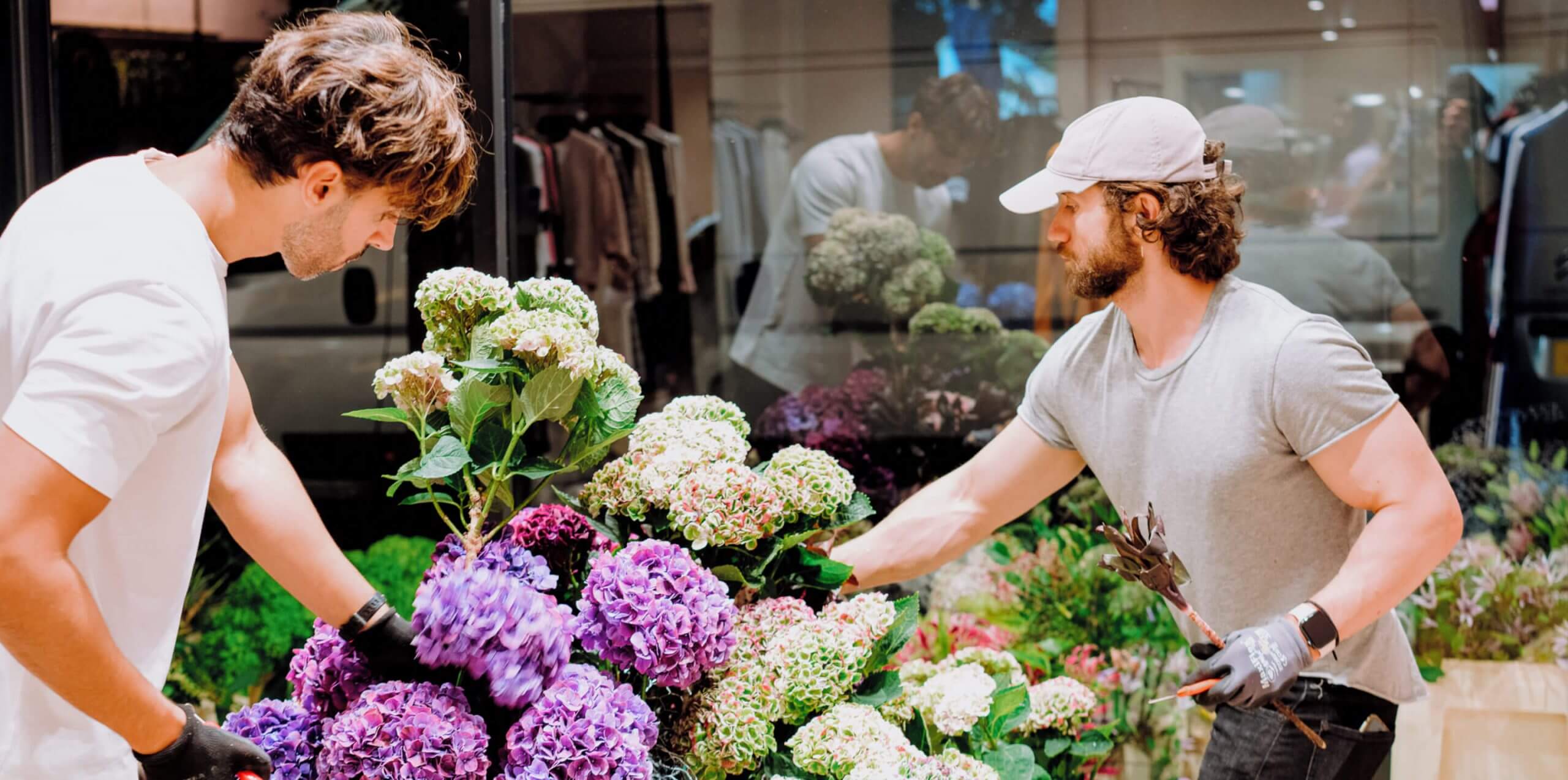
We left Aalsmeer with a clearer picture of the system we operate inside, and where the leverage actually is.
Sustainable floristry is not one decision.
It is hundreds of smaller ones, made consistently, across the entire chain.
That is the work, and we are still in the middle of it.
Follow our journey on Instagram @bloominghaus.
You may also like: